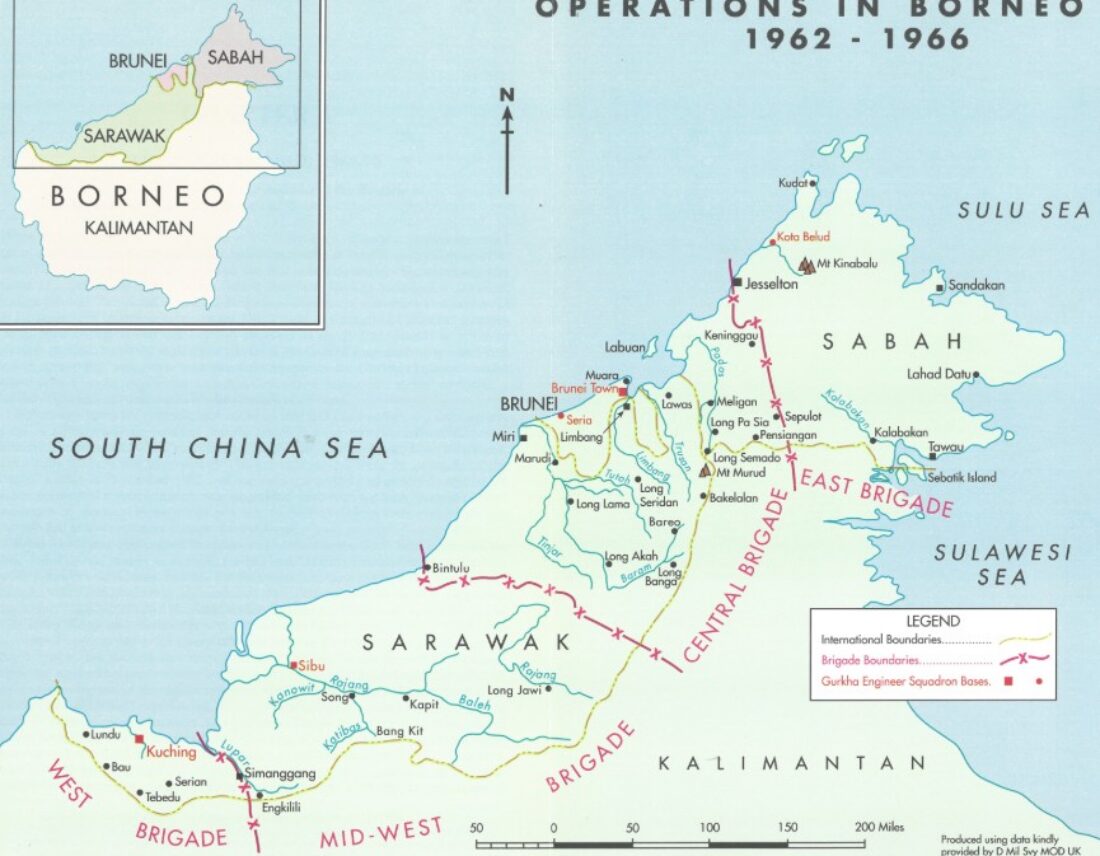
The Borneo Confrontation (Konfrontasi) was fought between Indonesia and the newly established Federation of Malaysia, supported by British and Commonwealth forces . Lasting from December 1962 to August 1966, it is widely regarded as one of Britain’s most successful undeclared wars of the Cold War, demonstrating how political restraint, military professionalism, and close international cooperation secured peace and stability in Southeast Asia.
The Gurkhas’ impact in Borneo extended far beyond the celebrated exploits of the rifle battalions. Units including the 2nd, 6th, 7th and 10th Gurkha Rifles conducted continuous patrols, ambushes, and reconnaissance along hundreds of kilometers of rugged border. Their ability to operate silently in dense jungle environments, often for weeks at a time, made them the ideal force for this type of warfare.
Their participation in Operation CLARET was particularly decisive: Gurkha patrols infiltrated into Indonesian territory to neutralise raiding parties and pre-emptive attacks before they crossed into Malaysia. Equally critical were the Gurkha Signals (now Queen’s Gurkha Signals), whose operators maintained reliable communications across vast expanses of dense jungle where conventional command networks often failed.
Deployed with the Gurkha Independent Parachute Company, SAS patrols, and forward reconnaissance teams, these specialist signallers used lightweight radios and high-speed Morse transmissions to relay intelligence, coordinate helicopter support, and link isolated patrols to higher headquarters, transforming scattered units into a coherent intelligence-led force.
Meanwhile, Gurkha Engineers (now Queen’s Gurkha Engineers) provided the mobility and infrastructure upon which operations depended. Working in some of the most remote terrain in Southeast Asia, they constructed and maintained border outposts, jungle tracks, bridges, helicopter landing sites, water supplies, and defensive positions, while also overcoming the constant challenges posed by rivers, swamps, and dense rainforest. Their efforts enabled troops to be supplied, reinforced, and evacuated across otherwise inaccessible regions.
The Gurkha Army Service Corps, retitled the Gurkha Transport Regiment (GTR) in 1965 and today the Queen’s Own Gurkha Logistic Regiment, provided the campaign’s logistical backbone. Its drivers carried supplies, ammunition, and equipment along hazardous jungle roads and remote tracks to dispersed units across Borneo. Protected by Ferret armoured cars, Gurkha transport convoys faced the constant threat of ambush, while also conducting security patrols around vulnerable camps and installations. Collectively, the Gurkhas delivered a decisive operational advantage.
Only one Victoria Cross was awarded during the Borneo Confrontation, earned by Lance Corporal Rambahadur Limbu of the 10th Princess Mary’s Own Gurkha Rifles for extraordinary gallantry in November 1965. His courage epitomised the professionalism and determination displayed by Gurkha soldiers throughout the campaign. Victory, however, came at a cost: British forces suffered 114 fatalities, including 43 Gurkhas, while 181 servicemen were wounded, among them 87 Gurkhas.
The Borneo campaign cemented the Gurkhas’ place within the modern British Army. Their exceptional mastery of jungle warfare proved decisive to success in Borneo, while the campaign itself became a defining model for modern British counterinsurgency.
The tactical and operational lessons refined during the Confrontation influenced and informed later British operations in Oman, the Falklands, and beyond.
The continued presence of Gurkhas in Brunei stands as a lasting testament to the partnership forged during the campaign. Read more about Britain’s Borneo 60 commemorations and attend one of the Borneo 60 events to discover why The Gurkha Museum Trust is leading one of the UK’s most comprehensive programmes marking the campaign’s 60th anniversary.