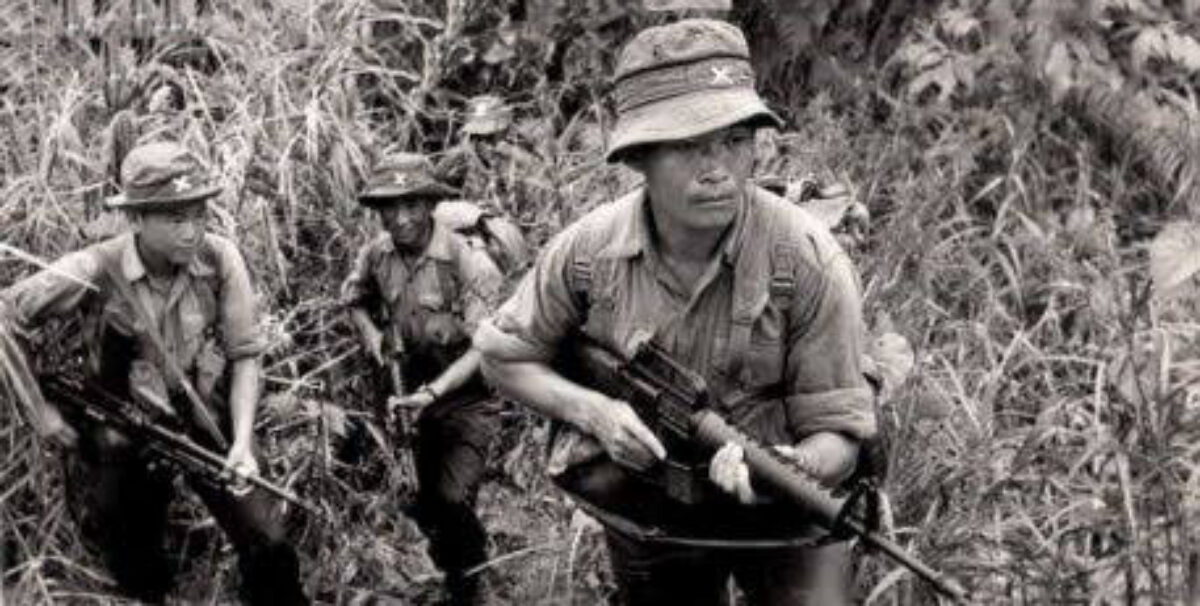
One of the first decisions taken at the very start of the campaign was to establish a “Hearts and Minds” operation to ensure that the indigenous inhabitants knew why we were there and to bring them onside. As I recall it, General Walter Walker, DOBOPS, called in Tom Harrison, who had organised the local resistance when the Japanese occupied Borneo in WW2, as an advisor. This initiative was to pay good dividends, particularly so that this concept was not adopted by the Indonesian military, who often abused the local people in their areas of operation.
The inhabitants of the Pensiangan area were largely Murut. Although their area straddled the border established in the previous century by the British and Dutch North Borneo Companies, prior to Confrontation, the border had been largely ignored by them. Five Murut villages in particular, three on the our (the British) side and two on the Indonesian side in Lumbis District, considered themselves as “Kith and Kin”. One of these, Labang, was located on the South bank of the Sembakung River. This was the same river that flowed through Sepulot and Pensiangan to then enter Indonesian territory.
That had been occupied by the Indonesian military as a Company Base, and they literally moved themselves into the village. From here they mounted several incursions over the border and, as a consequence, the inhabitants of one of the Murut villages on “our” side were forced to move to Sepulot. “Our” Muruts retained their links with those in Labang, and it became clear that they disliked the Indonesian military whom they regarded as an occupying force.
Geoffrey Lloyd had established good links with the civil administration in Pensiangan and, following the cross-border incursions, the decision was taken to attack the Indonesian base at Labang. But how to do so without causing casualties to the Murut inhabitants. Then news came through that the Muruts of Lumbis wanted to move into British territory, but were being prevented from doing so by the Indonesian military.
It was concluded that a combined military/civil operation was a feasible option and planning for this by Geoffrey Lloyd duly commenced. It was decided that a detachment of Battalion Headquarters would participate along with a Section of the Mortar Platoon (I cannot recall if these were 3In or the new 81mm Mortars!). The Battalion had just been issued with GPMG’s and a Machine Gun Section was formed by C Company for the operations, and training commenced. (I wonder if this was the first British Army operation in which GPMG’s were used in action?). I was RSO whilst Richard Willis was IO and Heli Tasking Officer, both of which tasks would be important for the operation. Also with us, was the RMO, Avo Basil, with an element of the Medical Section.
We duly deployed to Pensiangan by RAF helicopters, whilst additional Mortar and Small Arms ammunition were parachuted into Pensiangan. From here we were shuttled forward by helicopter to an LP not far to the border, which had been secured by C. Company, from where we commenced the march to the operational area. The route had already been recced by C Company and the Muruts, and the Muruts now joined us in carrying in the Mortar and GPMG ammunition. It was a day walk-in on a good trail, to where the force split. The main element of C Company cautiously made their way into a position on the North bank of the river, which overlooked the village and Indonesian position on the other bank. Bn HQ and the Mortar Section were located further back on the ridge. Here the Base Plate position was prepared and we set up our shelters for our overnight stay. We had taken Dry Rations so that no cooking or lights would be necessary. The only disturbance was when a leach got up Colonel Runce’s nose and the RMO had to be roused to extract it!
In the meantime, the Muruts in the village had been discreetly preparing for their evacuation. Much of their goods and livestock had been taken down to the river, where their boats ferried them over to the other side. That evening the villagers gave a pre-arranged party for the Indonesian soldiers then, in the early hours they left the Indonesian military sleeping; and descended to cross the river over to our side. At about 02.00 we got the message from C Company that all the Muruts had safely crossed and moved away from the riverbank into the forest.
We Stood-To an hour before dawn. I was with my signaller on the Bn Net to working to C Company. Beside me was OC Mortar Platoon on the Mortar net. As dawn broke, Geoffrey gave the message to open fire. Our first salvo of mortar fire commenced and at the same time, C Company opened up with GPMG and small arms fire. We heard the crump of the mortars exploding and shortly after that the Indonesians returned fire with their Mortars and sporadic small arms. However, their Mortar shells were hitting forward to our position and behind that occupied by of C Company, so inflicting no harm on us. Then there was severe interference on the Mortar radio net. We realised that what was happening was that the Indonesian radio operator was frantically calling for assistance. I immediately got on the radio and told the MFO to switch to the BN Command Net, which he did. I stood by the Mortar Base Plate position and passed on his directions. Then the MFC said “On Target, drop one metre”. Then he laughed and said that the last salvo had been a direct hit on what seemed to have been the enemy Command Post in the village. Certainly, the radio interference ceased at that point. C Company now reported that the enemy were retreating into the trees beyond the village; and called for further fire. A salvo of WP Smoke was fired which exploded on the treetops given an indication of their position. We fired off a further salvo of HE, with no response from the enemy. So “Cease Fire” was called. We had suffered no casualties.
The march back to the LP then commenced with a break for Bhat, followed by the heli lift back to Pensiangan, where a Rum Issue was approved by the RMO! The Muruts were thanked for their help and co-operation, without which the operation could not have taken place. Some days later, some of the Muruts re-crossed the river and quietly returned to the village. They reported that there were 15 dead enemy. More must have been wounded. Following our attack, they had retreated down-river from where they could be evacuated by boat. They never re-occupied that position or undertook any further offensive operations in our area. So, the operation fully achieved its aim, with no casualties on our side.
Subsequently, some of us including, I know, Richard Willis as well as myself, were a bit surprised that no submissions for Honours and Awards were forthcoming. As I recall it, the response of the CO was that everyone had done their duty as expected. Quite so, but I still have the feeling that other units might have seen it differently!
Soon after this operation, I left 2/7 GR on long leave, and was then Seconded to Gurkha Parachute Company as 2 i/c, with whom I served two further operational tours in Borneo, under the command of John Cross.
Footnote.
My thanks to The Gurkha Museum for access to the their Confrontation records and to my son-in-law, Major Stuart lusher who went through these and extracted and photocopied those that might be relevant. Mike Allen.