In Service and In Memory: Remembering Britain’s Gurkhas
In Service and In Memory: Remembering Britain’s Gurkhas
Since 1815, roughly 350,000 Gurkhas have served the British crown. Due to poor record keeping in the Indian Army during the 1800s, it is not possible to know exactly how many Gurkhas have died in British service. However, from the records that are available, we can estimate that at least 17,000 to 20,000 have died fighting for Britain.
As we approach remembrance Sunday, let us explore how Britain has cared for and commemorated its fallen Gurkhas, both historically and into the present day.
Early Years
The first British built memorial that honours Gurkha soldiers dates to the origins of British Gurkha service. During the Anglo-Nepal War (1814-1816), British and Indian soldiers clashed with Gurkha warriors at the fortress of Kalunga. The losses were heavy on both sides, with the British column suffering almost 50% casualties.
After eventually capturing the fort, the British built two memorials on the site. One commemorated General Rollo Gillespie and other British soldiers killed in the fighting. The other paid tribute to the Gurkha commander, General Balbhadra, and his warriors, with whom the British had developed a wary respect.
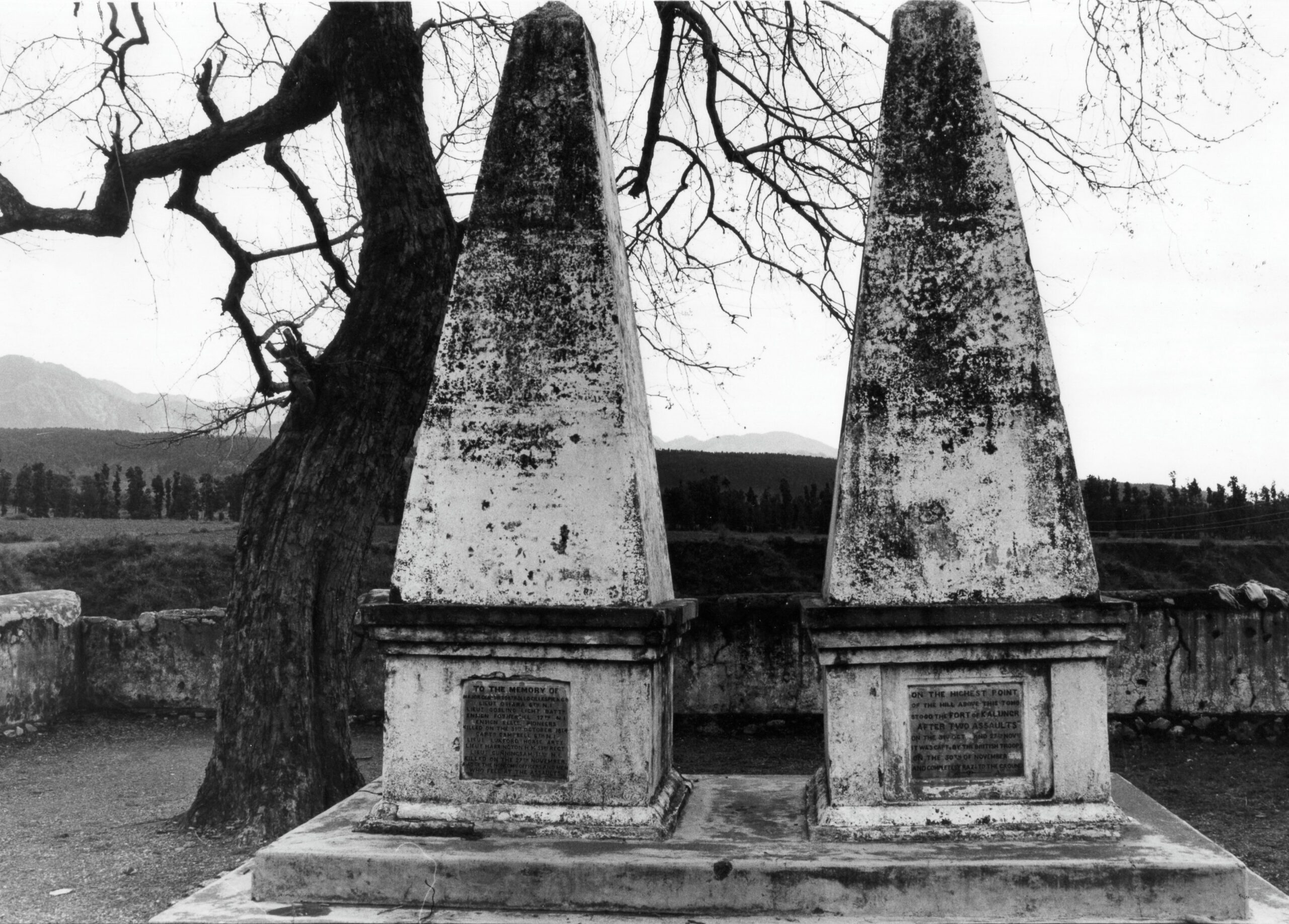
The twin memorials at Kalunga…
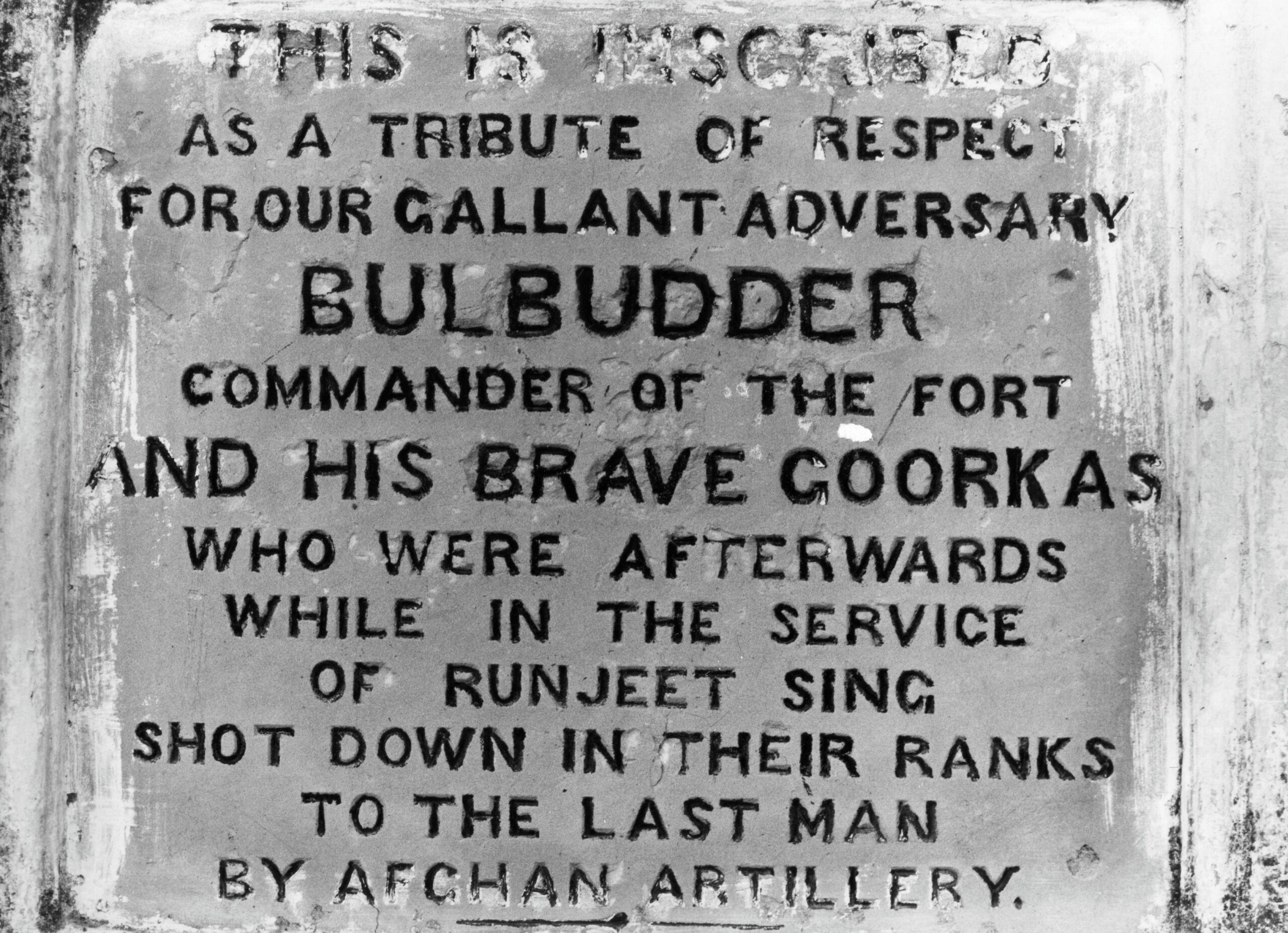
…And the inscription that honours ‘our gallant adversary’ and his brave Gurkhas.
By the early 1900s there were ten Gurkha regiments in Britain’s Indian Army, each one with a permanent depot. When a Gurkha died at his regimental depot his body was treated in accordance with the wishes of his family, who could choose whether he was buried or cremated. Where possible, depots would have a cemetery for their soldiers. For Gurkhas killed on active service, their bodies were often cremated in accordance with Hindu religious practices.
There are few details on memorials or cemeteries for Gurkha soldiers in British service that date to the 1800s. This is not surprising – Gurkhas most often served in the remote and inhospitable terrain of India’s North West Frontier. The largely temporary nature of British garrisons there prevented the construction of permanent cemeteries.
However, the 20th century marked a huge change in Britain’s commemoration of fallen soldiers, whether they be British, Indian or Gurkha. This change was brought about by the First World War, which saw casualties on a scale previously unimaginable.
‘Some corner of a foreign field…’
When we consider the legacy of the First World War, one of the enduring images that we imagine are the cemeteries built by the Commonwealth War Graves Commission (CWGC). The white headstones, arranged in neat rows beside the French countryside, are now symbolic of the fallen of both world wars.
During earlier conflicts, soldiers were often buried in communal graves close to the battlefield, with no rigorous procedure for recording burial information. During the First World War, this practice was no longer acceptable to the British public. In large part, this was because most of Britain’s war dead were civilian volunteers. The families of these soldiers wanted to know that their loved one had been properly buried, and that they could be visited once the war had finished.
Fortunately, there were those who had anticipated this concern. From March 1915, dedicated grave registration units began operating along the British frontline, recording and marking burials.
When the CWGC was established in 1917 it built on these efforts, and began consolidating fallen soldiers into properly planned cemeteries. In the 1920s, these cemeteries were developed into what we recognise today. During the Second World War, this earlier experience was built upon, and the CWGC established grave registration units everywhere that British, Indian and Commonwealth soldiers were fighting.
The CWGC registers list thousands of Gurkha burials, across locations like France, Italy, India, Burma and North Africa. For the CWGC, Gurkhas and Indian soldiers sometimes required slightly different arrangements from their British counterparts. Because of their Hindu faith, many fallen Gurkhas were cremated instead of buried.
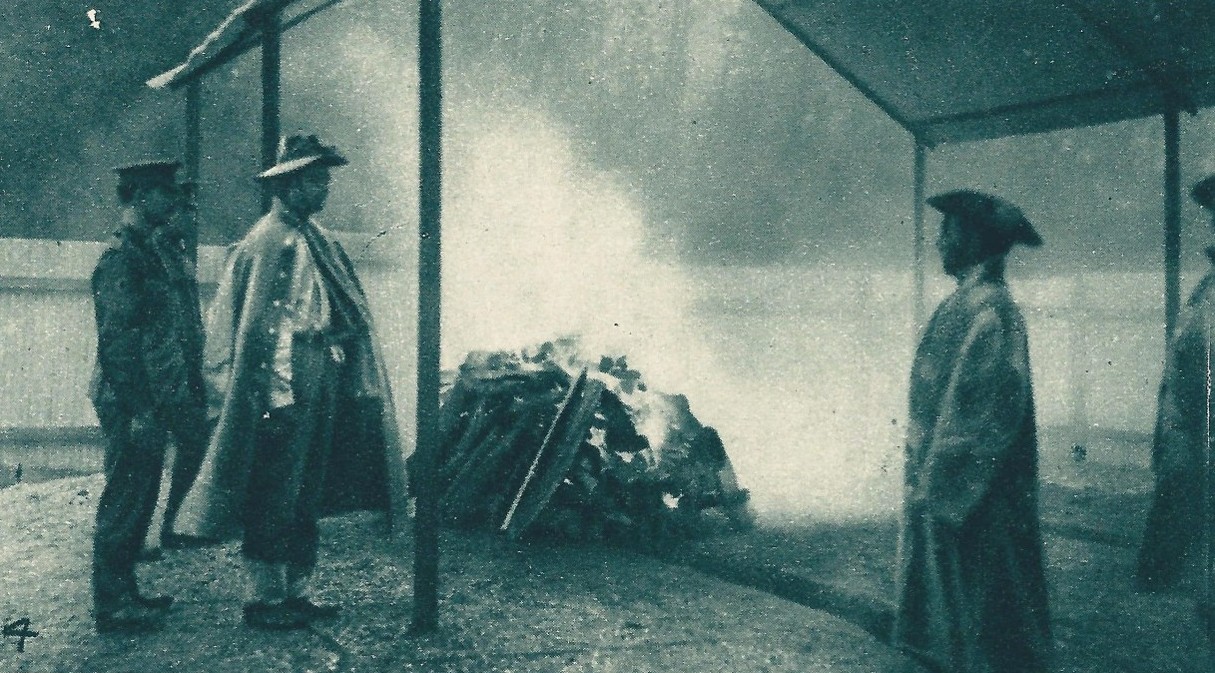
The cremation of Jemadar Harakbahadur Thapa, 3rd Gurkha Rifles, at Netley Hospital, Hampshire. January 1915.
In those cases, the soldiers names would be inscribed on a memorial instead of a headstone. Though many Gurkhas were cremated, burial was not uncommon and Gurkha gravestones can be found in many CWGC cemeteries.
Possibly the largest concentration of burials is at the Rimini Gurkha War Cemetery in Italy. The cemetery was begun in autumn 1944, during the battles at the Gothic Line. The 4th and 10th Indian Divisions saw a lot of this fighting, and suffered a large share of the casualties. The Gurkha cemetery at Rimini holds 618 burials and the Rimini Cremation Memorial.
Other large concentrations of Gurkha burials in Italy can be found in the cemeteries near Monte Cassino, where hundreds of Indian soldiers were killed during the four battles there.
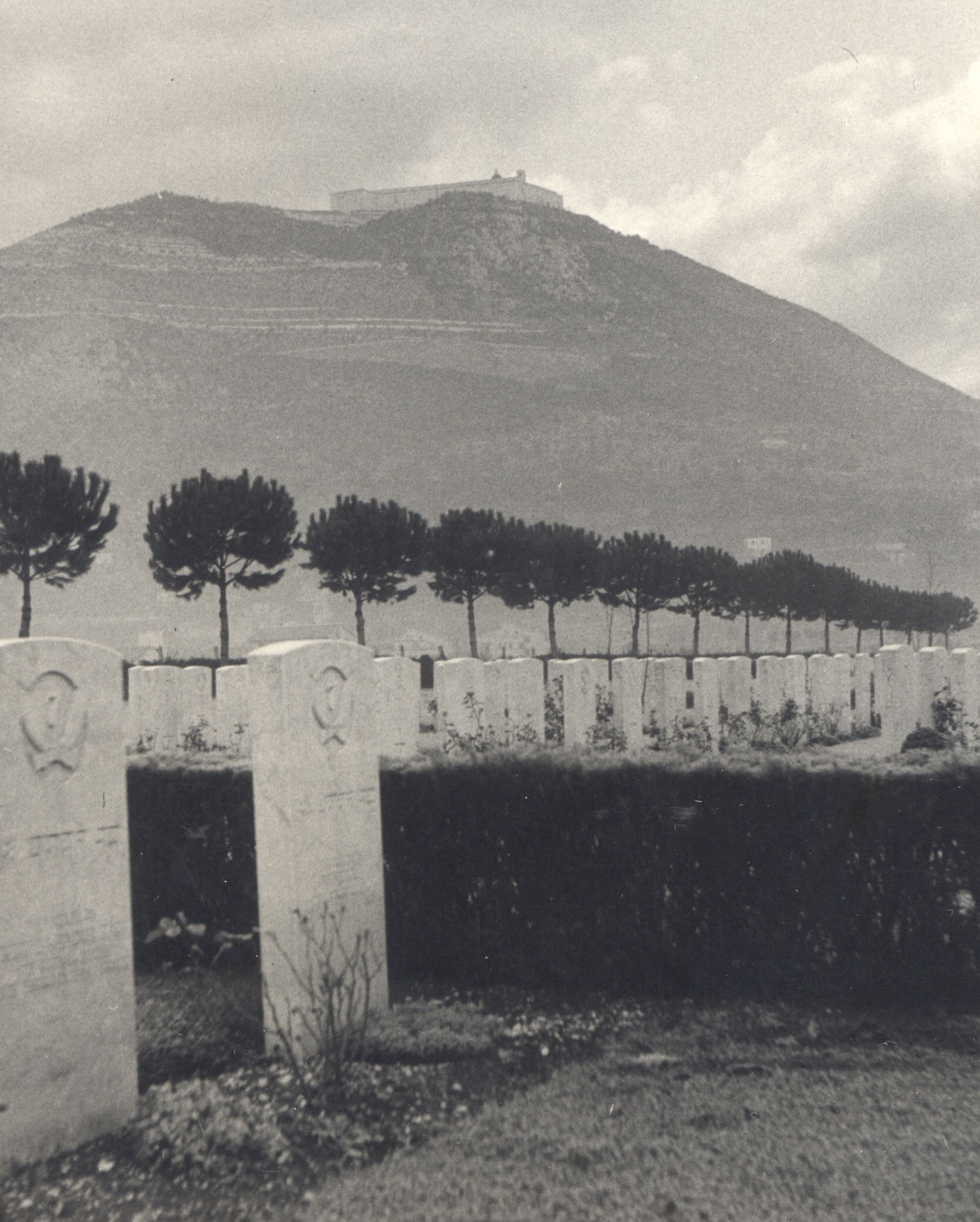
Gurkha headstones at the foot of Monte Cassino.
As much as was possible, a soldier was interred with respect to their faith. Many Gurkha headstones include the Hindu Om symbol (ॐ), whilst Buddhist Gurkha headstones bare an engraving of a stupa:
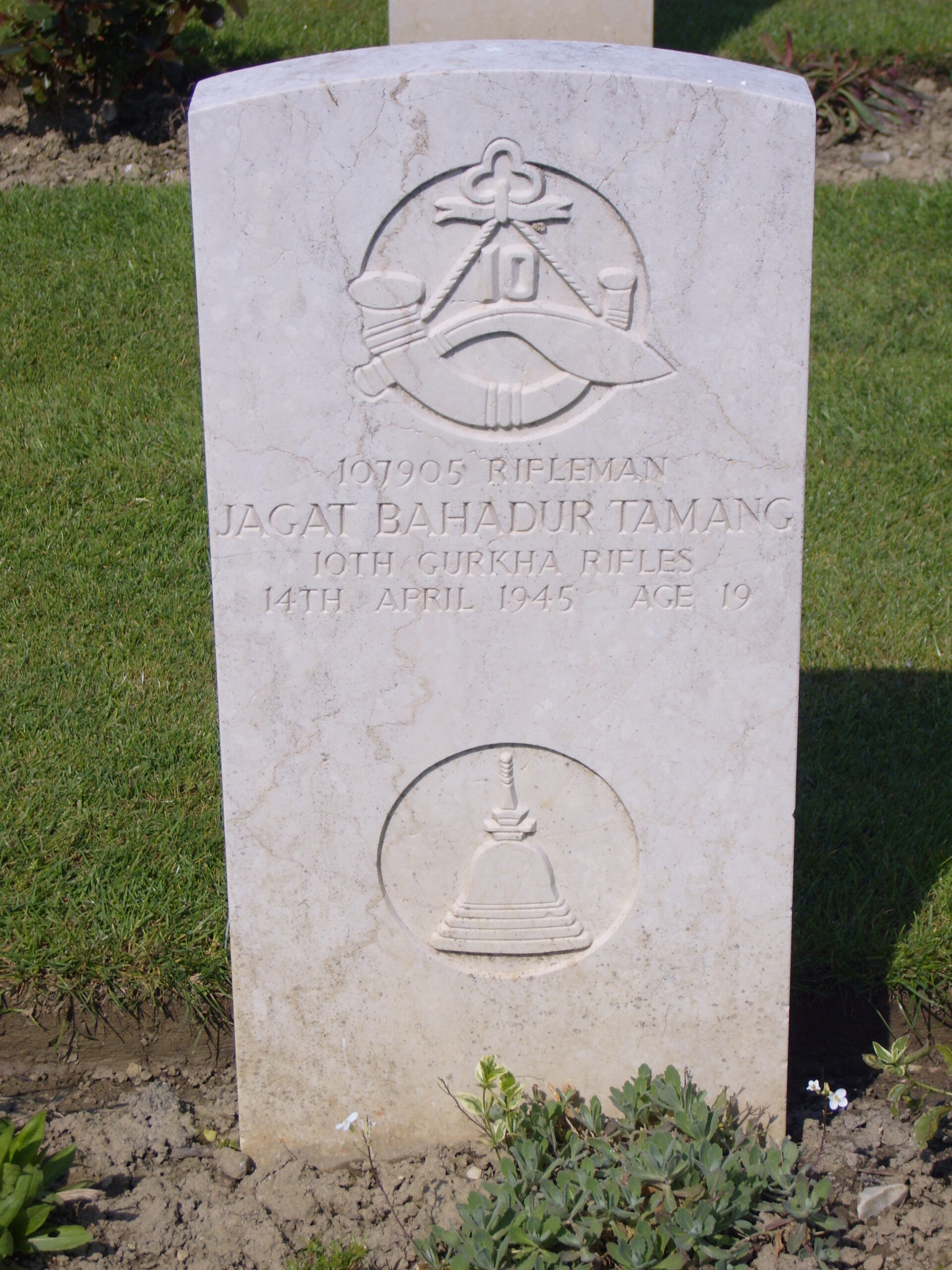
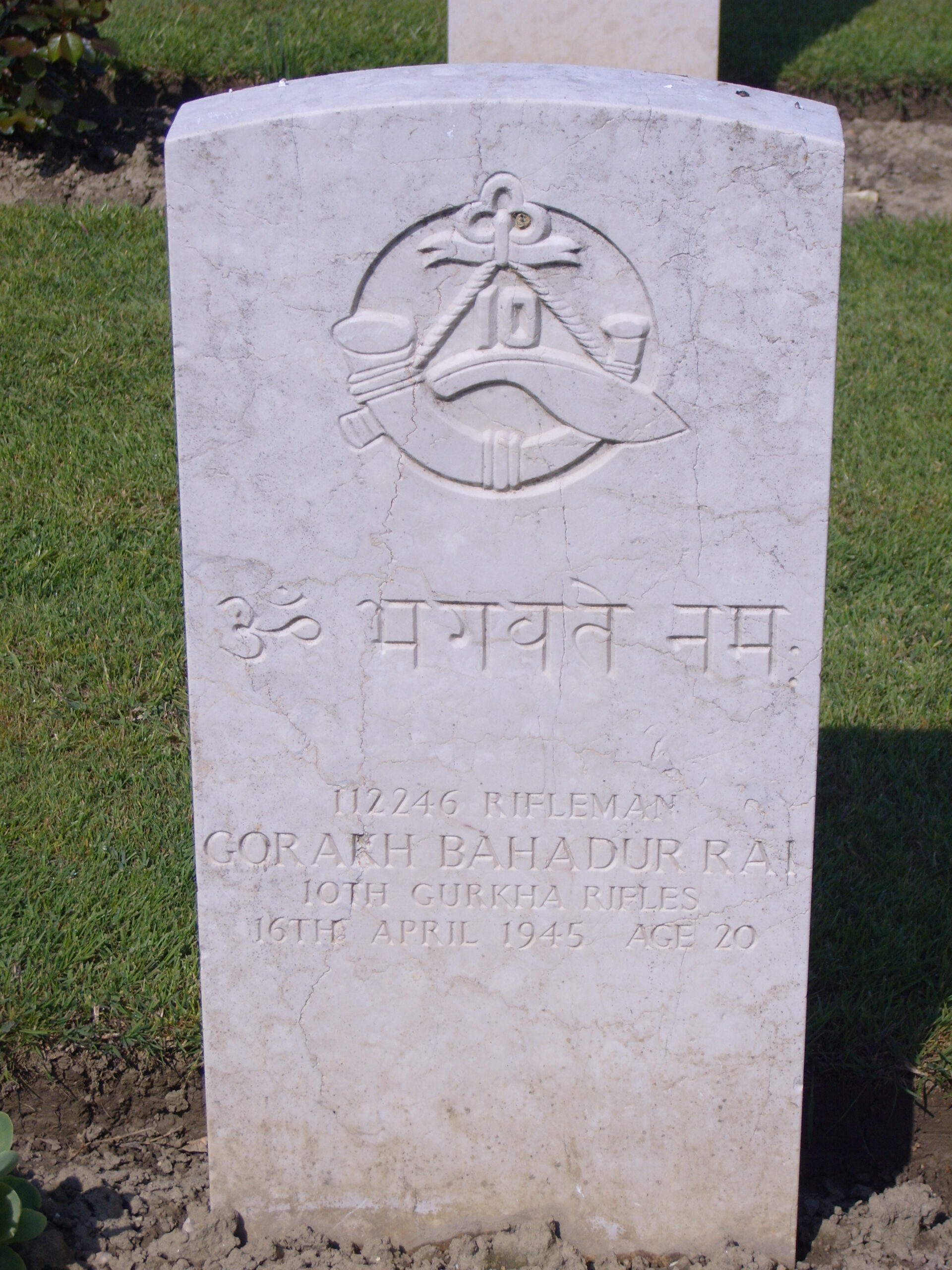
The graves of two men of the 10th Gurkha Rifles at Rimini Gurkha War Cemetery, one Buddhist (above) and one Hindu (below).
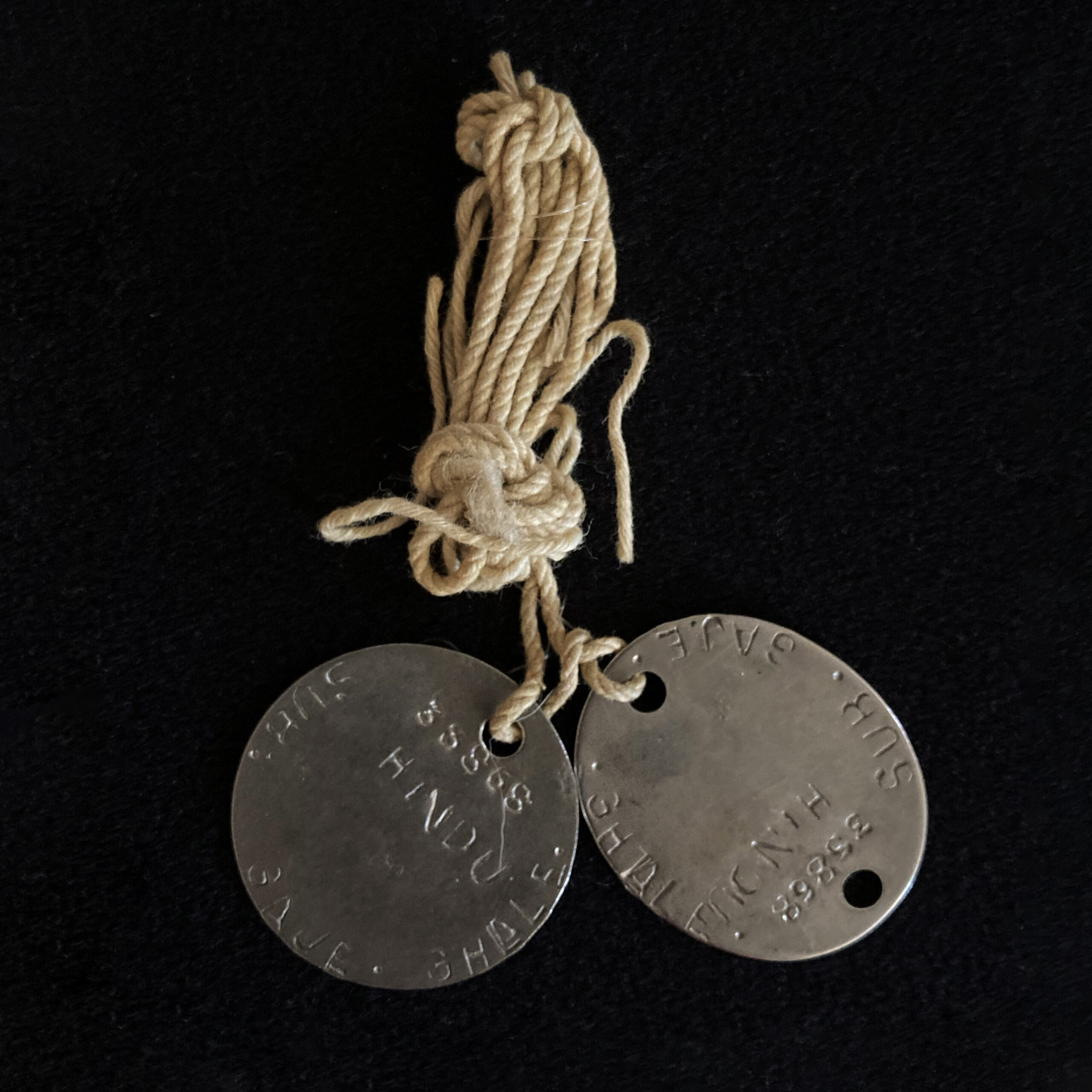
ID Tags of Gurkha Victoria Cross recipient Havildar Gaje Ghale. ID tags noted the religion of the wearer so that an appropriate burial could be arranged in the event of their death. On the left hand disc, Gaje is listed as a Hindu.
For Gurkhas who have no known grave, their names are recorded on memorials to the missing. A notable example of this is the Neuve Chappelle Memorial, which commemorates over 4,700 Indian Army soldiers and military workers who died on the Western Front and have no recorded burial place. It bears the names of hundreds of Gurkhas who were killed in the bitter fighting of 1915.
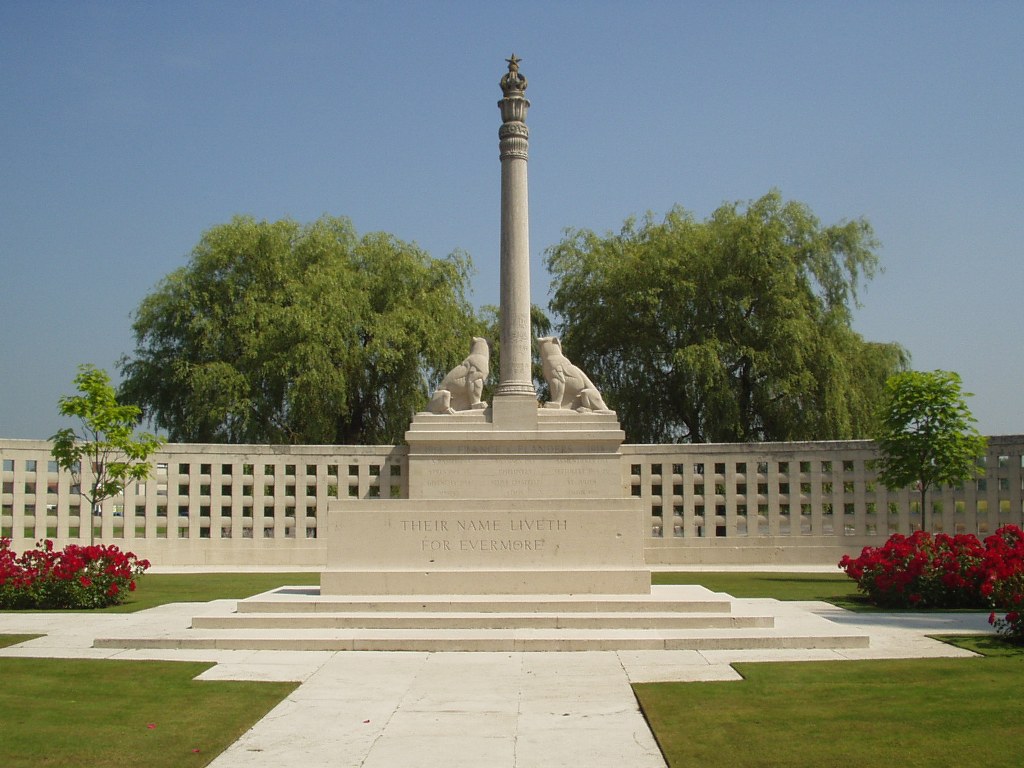
Indian Army Memorial to the missing at Neuve Chappelle
Gurkhas who were listed as missing during the Second World Wars Burma Campaign are recorded on the Rangoon Memorial in Burma, which lists the names of around 27,000 Commonwealth soldiers.
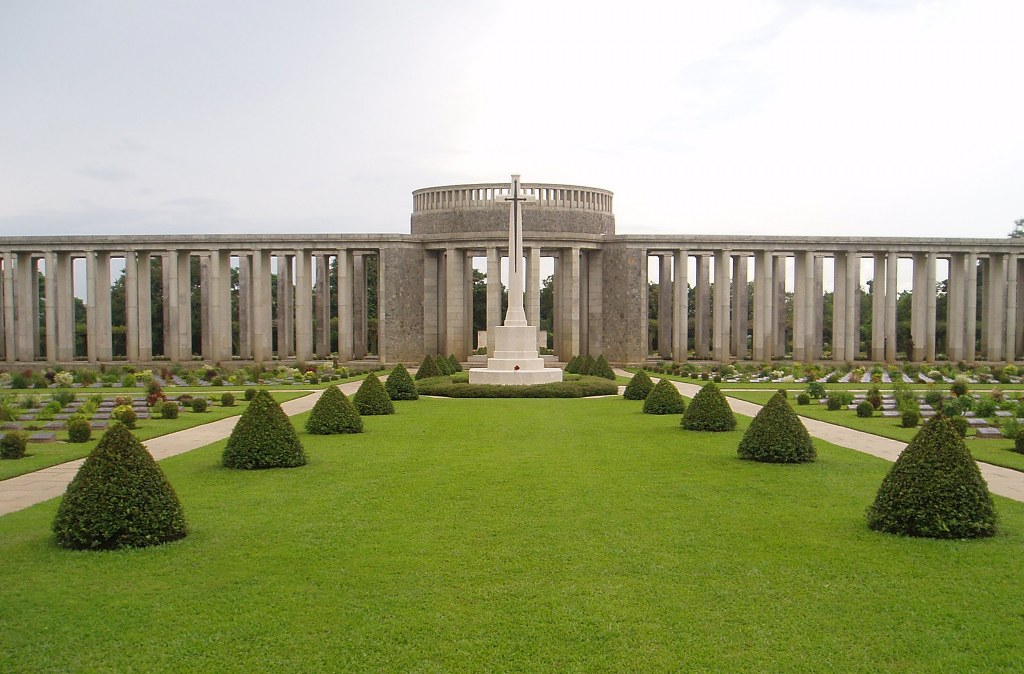
The Rangoon Memorial to the missing of the Burma Campaign.
Gurkha regiments also made their own commemoration efforts. For example, the 4th Gurkha Rifles (4GR) cast two bronze memorial bells, unveiled in 1927. After the First World War, the families of British and Commonwealth soldiers who were killed received a bronze plaque bearing the soldiers name, as a token of remembrance. Because parts of Nepal were nigh-inaccessible to non-Nepalis until the 1950s, 4GR were unable to deliver many of their plaques. Instead, they melted them down and used the metal to cast the bells, which were rung each day.
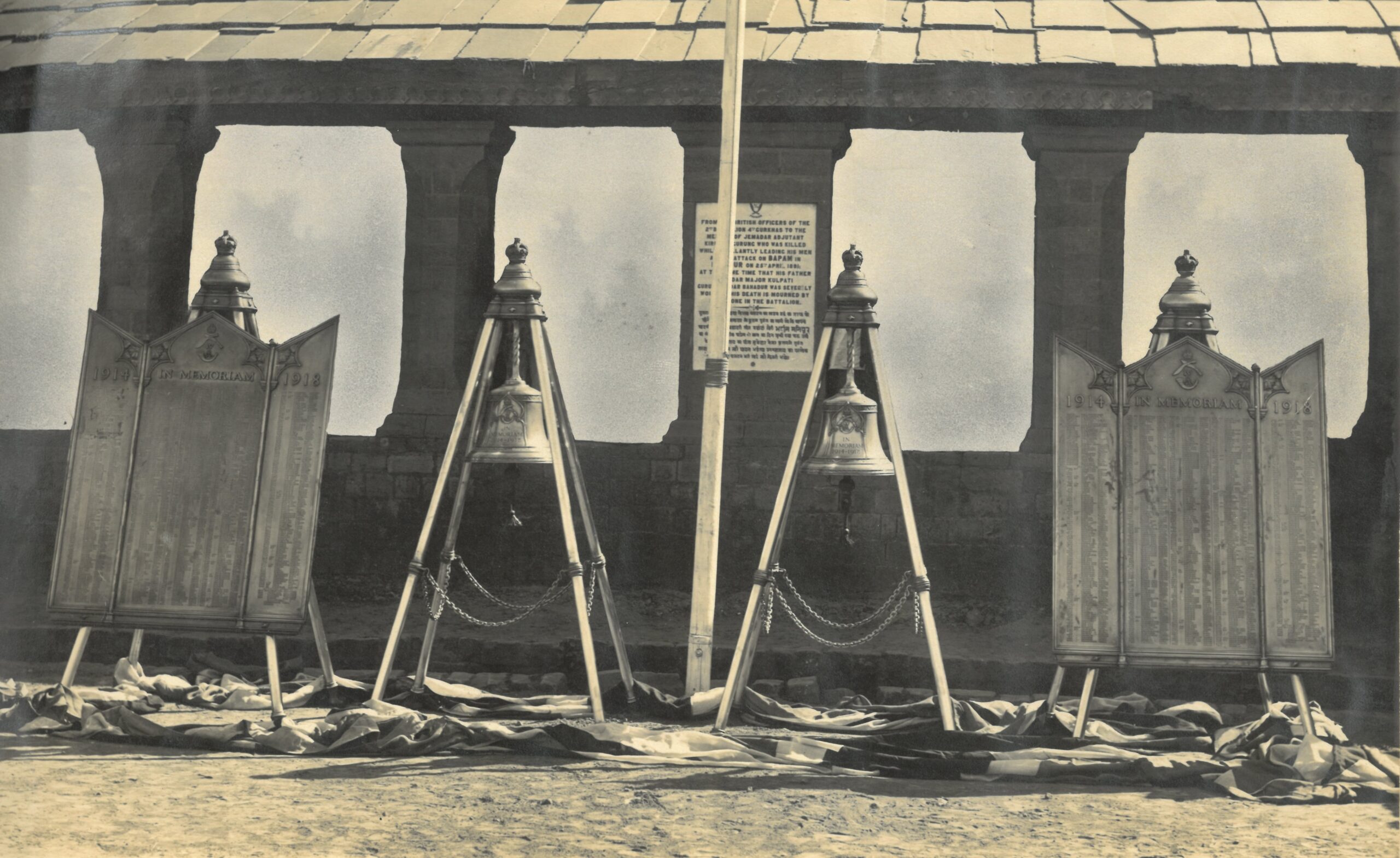
The memorial bells at the 4th Gurkha Rifles regimental centre, 1927.
After the Second World War, Gurkha units were increasingly garrisoned in Singapore, Hong Kong and Brunei. Over the following decades these garrisons evolved into communities, becoming home to not only Gurkha soldiers but also their families. These communities needed space to bury their dead, and subsequently Gurkha cemeteries were started across Malaya.
Gurkha cemeteries such as those at Kranji, Kluang, and Sungei Patani became the resting place of many Gurkhas who were killed in the conflicts in Malaya and Borneo between 1948 – 1966.
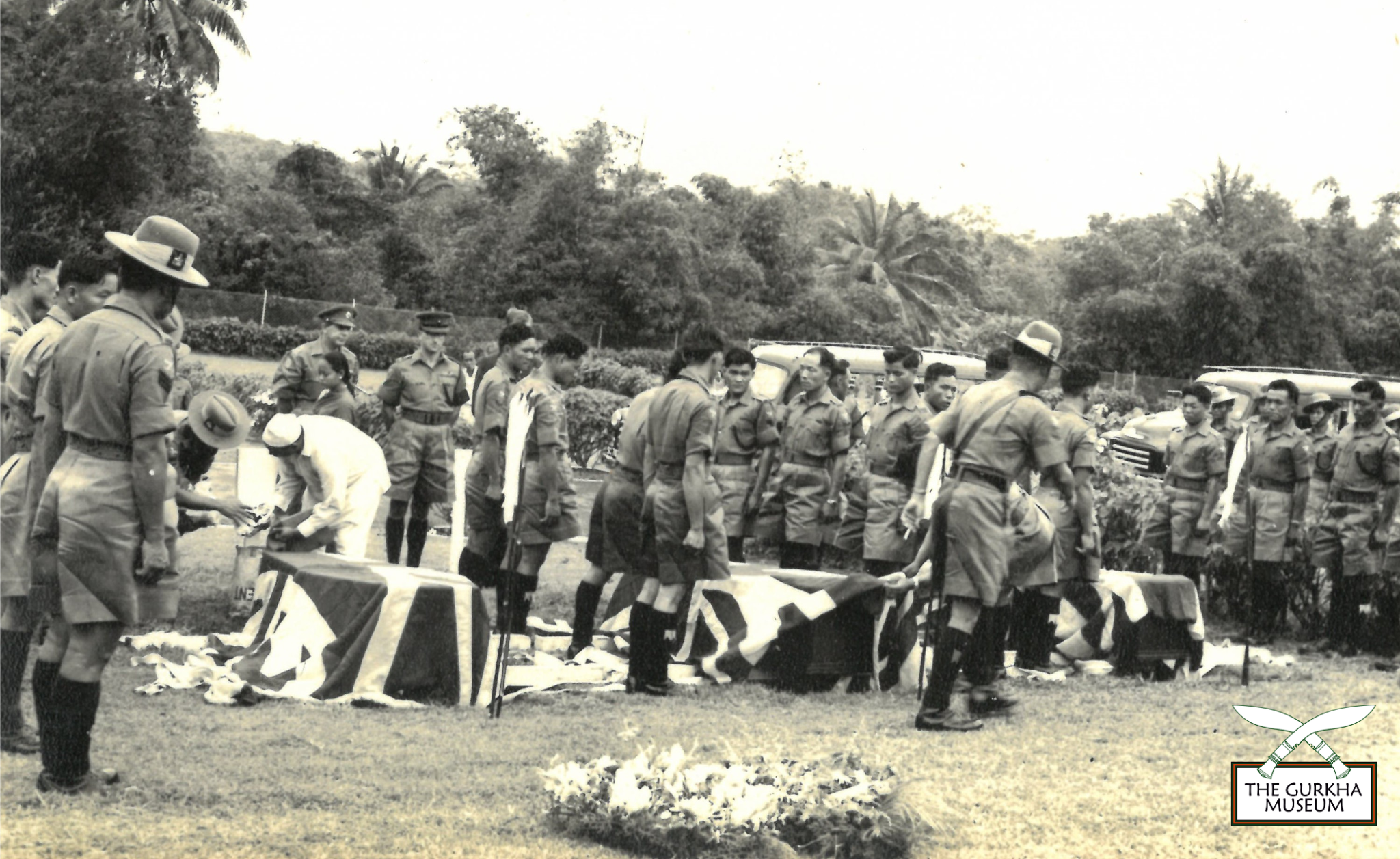
Three Gurkha soldiers killed in action in Borneo are interred at Ulu Pandan, Singapore, 1964.
Commemoration in the UK
Since the late 1990s, the Brigade of Gurkhas has primarily been garrisoned in Britain. The British Nepali community has also flourished across the UK as Gurkhas settled here after their service.
As Gurkhas became more visible in everyday life, the British publics appreciation for their service and sacrifice increased. The first dedicated memorial in the UK for Gurkha soldiers was unveiled by Queen Elizabeth II in December 1997. Located on Horse Guards Avenue in Whitehall, the statue depicts a Gurkha soldier in First World War uniform. Despite the uniform, the memorial is not intended to represent fallen Gurkhas from any specific conflict. Instead, it represents all Gurkhas killed in service to Britain since 1815.
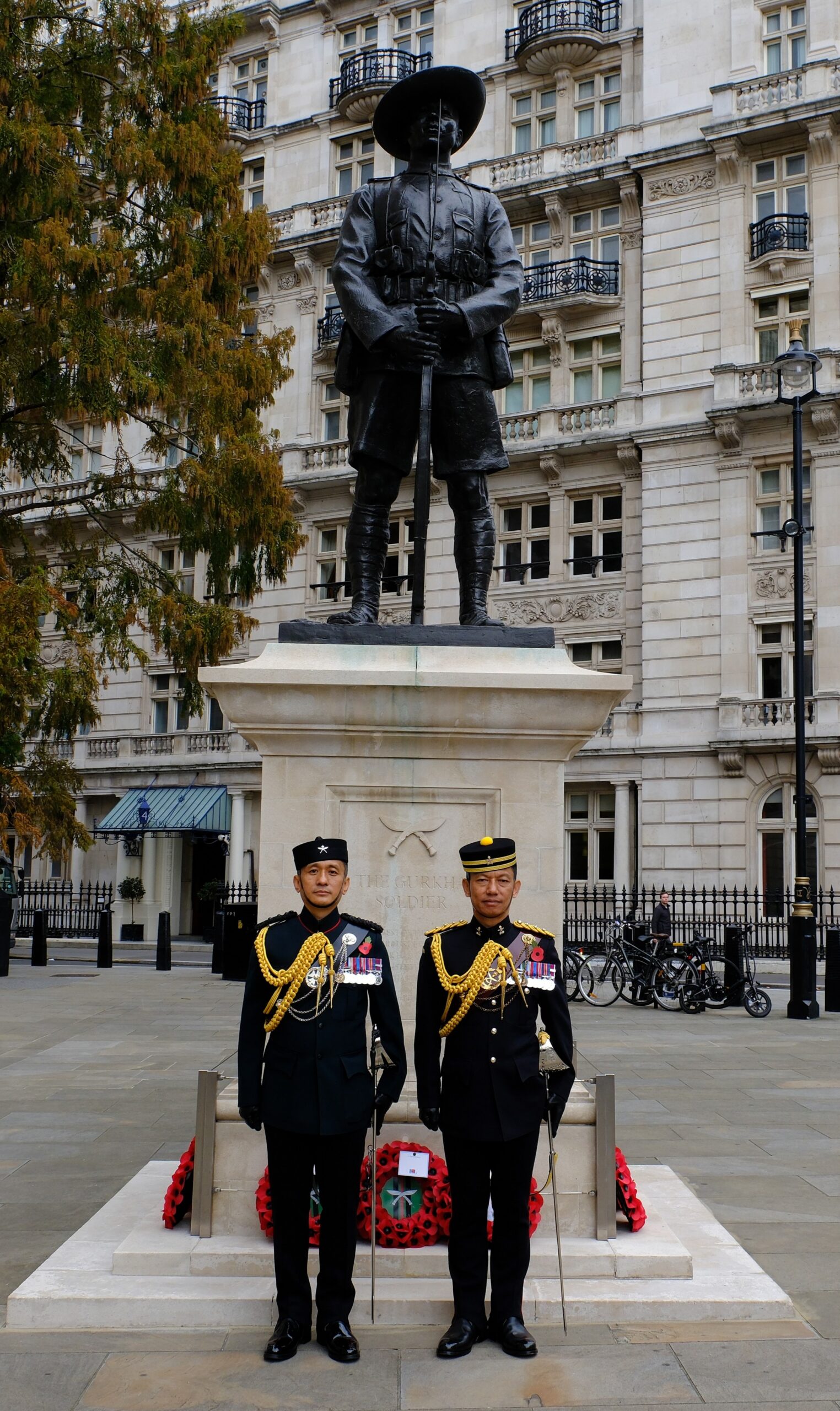
Two Gurkha orderly officers at a wreath laying ceremony at the Gurkha memorial in Whitehall, November 2025.
Other major memorial sites in the UK include the Chautara tree at the National Arboretum in Staffordshire. Chautara trees, which are usually planted on raised stone platforms, are common sights in Nepal. They serve as special resting areas for travellers making their way across Nepal’s hilly terrain. The Chautara at the National Arboretum is intended as a place to sit in quiet reflection.
In addition to national memorials, Nepali community groups in the UK have also built sites of commemoration. In 2021, the Greater Rushmoor Nepalese community raised £180,000 to commission a statue of Rifleman Kulbir Thapa, the first Gurkha to be awarded the Victoria Cross. The statue celebrates over 200 years of Gurkha service and stands in the Princes Garden in Aldershot.