Life at Changi
Changi Jail was a civilian prison prior to the war, having been built by the British in the late-1930s. After the capture of the city, the Japanese Army requisitioned it as the core of a new camp to hold civilian internees and PoWs. Over the next several weeks the camp expanded, growing to encompass the British barrack complex at Selarang. The barracks soon became overcrowded; designed to accommodate just 5,000 men, it quickly came to hold over 55,000 PoWs.
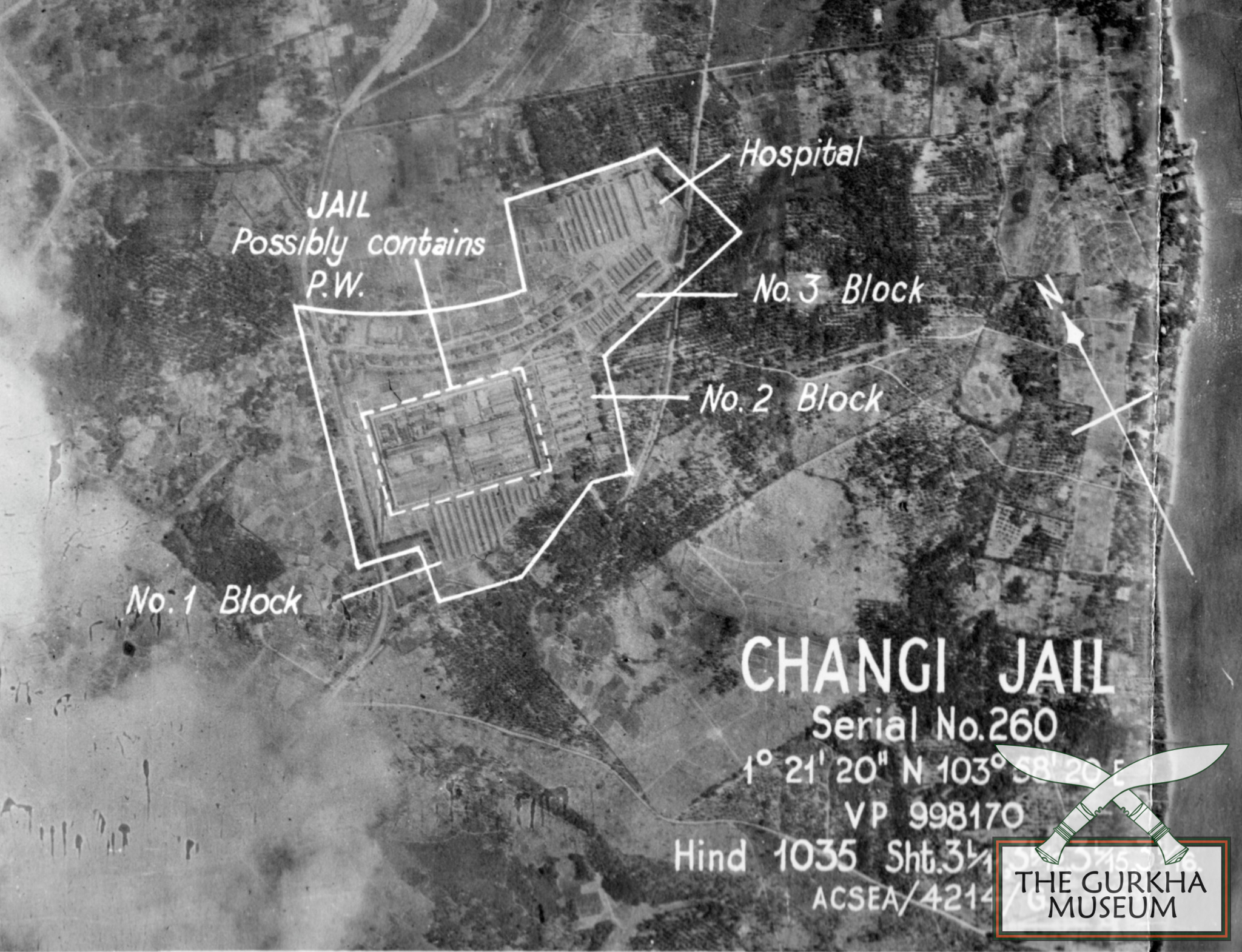
Aerial view of Changi Jail, c 1942 – 45
Privations began immediately. Meagre rations and cramped, unsanitary conditions meant that sickness spread rapidly among the PoWs, with breakouts of malaria, dysentery and beri-beri becoming frequent. What’s more, any perceived disobedience by the PoWs would often result in harsh beatings from their captors.
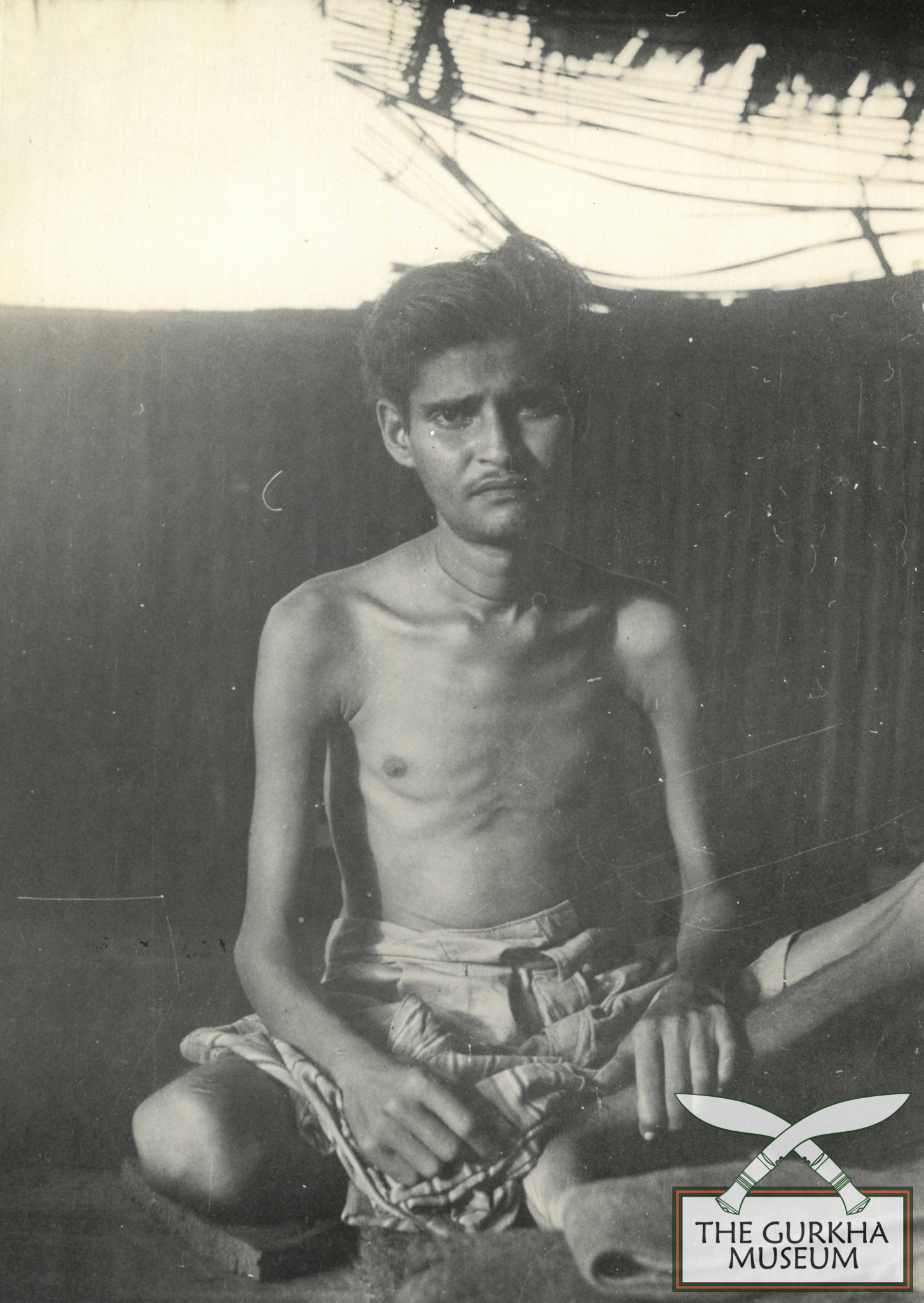
An Indian PoW at Changi, photographed in 1945.
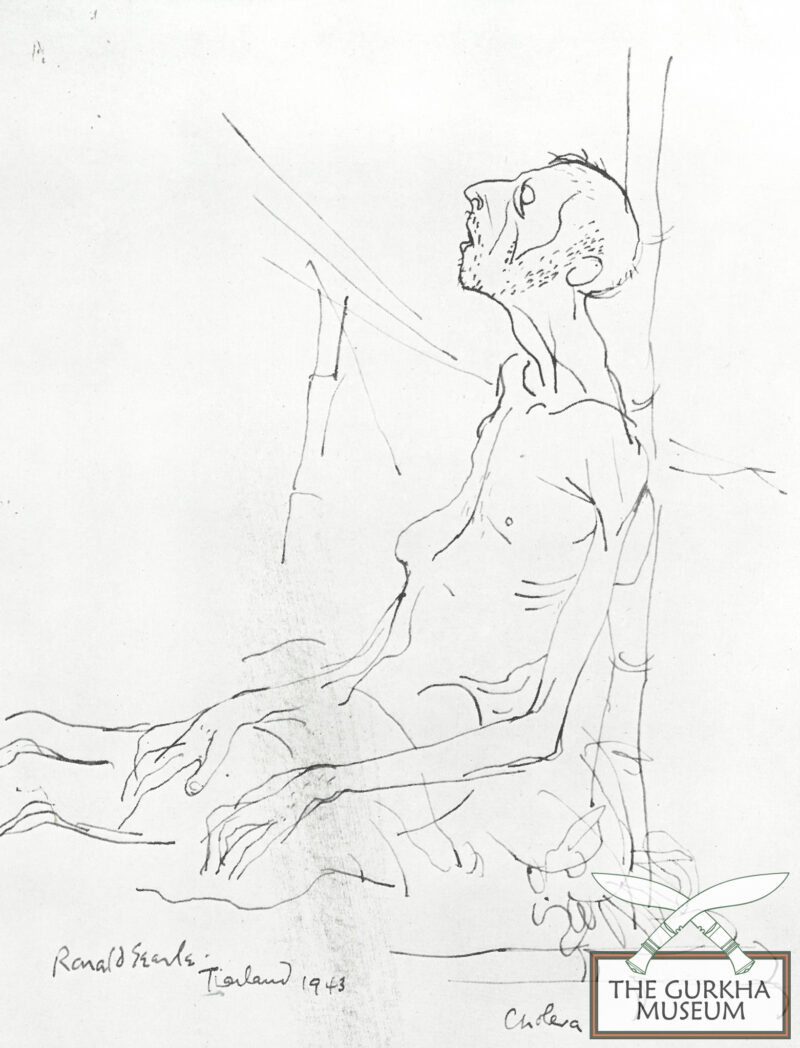
Perhaps the greatest agony for PoWs at Changi was selection for work details along the Burma-Thailand Railway. Beginning construction in 1942, the Japanese used thousands of PoWs and civilians as slave labourers along the railway, many of whom were drafted in from Changi. Forced to work in appalling conditions, deaths from accidents, exhaustion and disease were so frequent that it began to be referred to as the ‘death’ railway. The terrible conditions in the labour camps, and the indignities suffered by the PoWs, were later described by Major Evans of the 2nd Battalion, 2nd Gurkha Rifles (2/2GR):
‘Prostrate and naked officers and other ranks lay in tents made from single flys or from tattered tarpaulins. These tents were filled to overflowing with the sick; through holes the incessant rain beat upon the inmates. Struggling to reach the deep trench latrine, the weakest could be seen crawling on their hands and knees, their hair long and unkempt, their bodies no more than skin and bone covered by sores. Many lay motionless, the food which had been given them lying in their open mouths through lack of strength to work their jaws’.
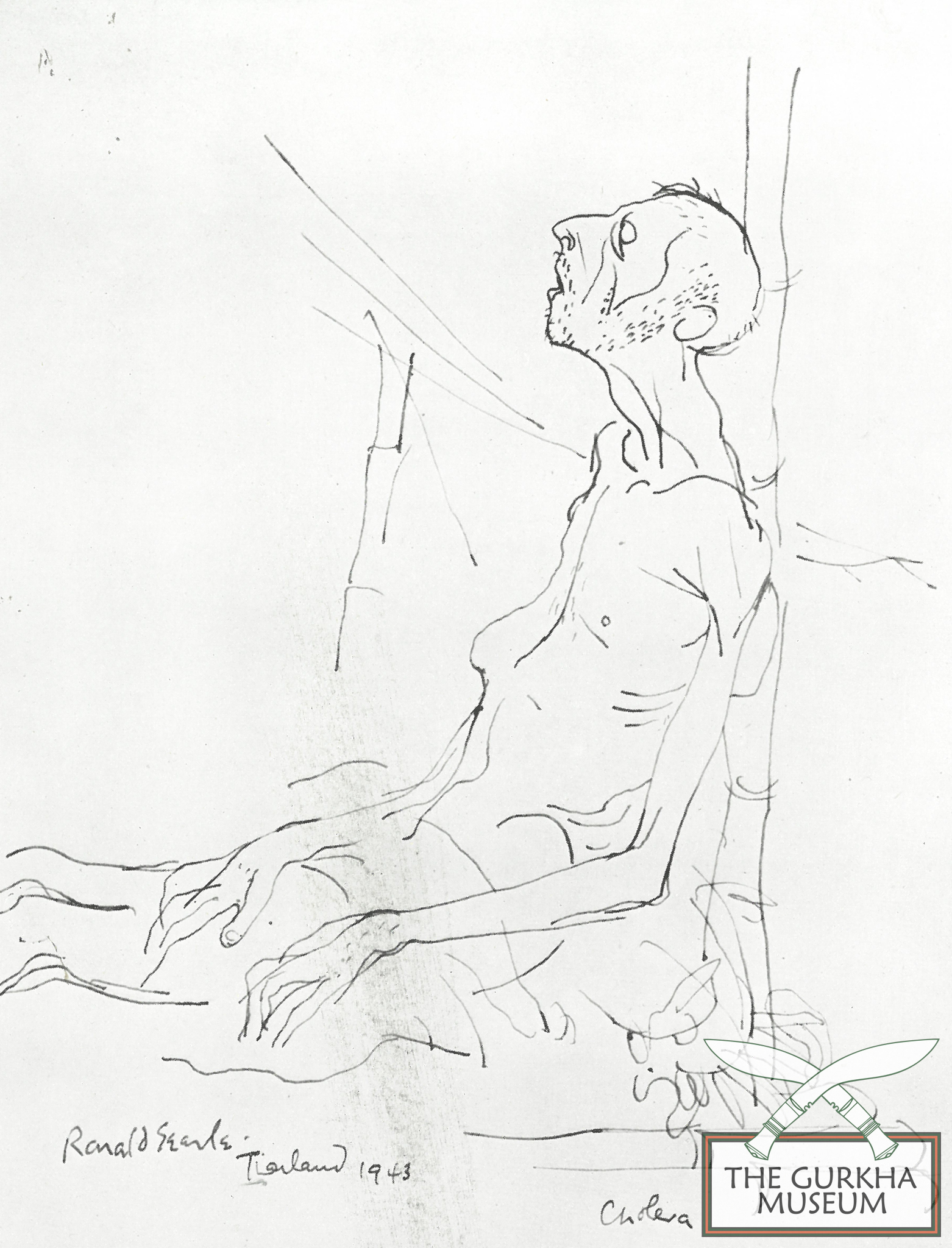
A British prisoner on the Burma-Thailand Railway stricken with cholera, depicted in 1943 by Ronald Searle. Searle, who served in the Royal Engineers, produced dozens of harrowing sketches whilst a PoW at Changi.
Despite the many cruelties they faced, the PoWs at Changi did not suffer passively. As the Gurkha soldiers were separated from their British officers shortly after their arrival at the camp, it was the senior Gurkha officers that would keep their battalions together. Notably among them were Subedar Majors Hari Sing Bora and Kalu Sing Chhetri of 2/2GR.
Subedar Hari Sing firmly resisted efforts by the Japanese recruit Gurkhas into the Indian National Army, an armed force of Indian nationalists that were deployed against the Allies in Burma. For his defiance, Subedar Hari Sing was tortured by the Japanese, and in May 1944 he died from injuries inflicted by his captors. His place was taken by Subedar Kalu Sing, who continued his predecessors resistance against the Japanese. Subedar Kalu Sing also endured terrible abuses, but kept his men together until their eventual liberation in 1945.
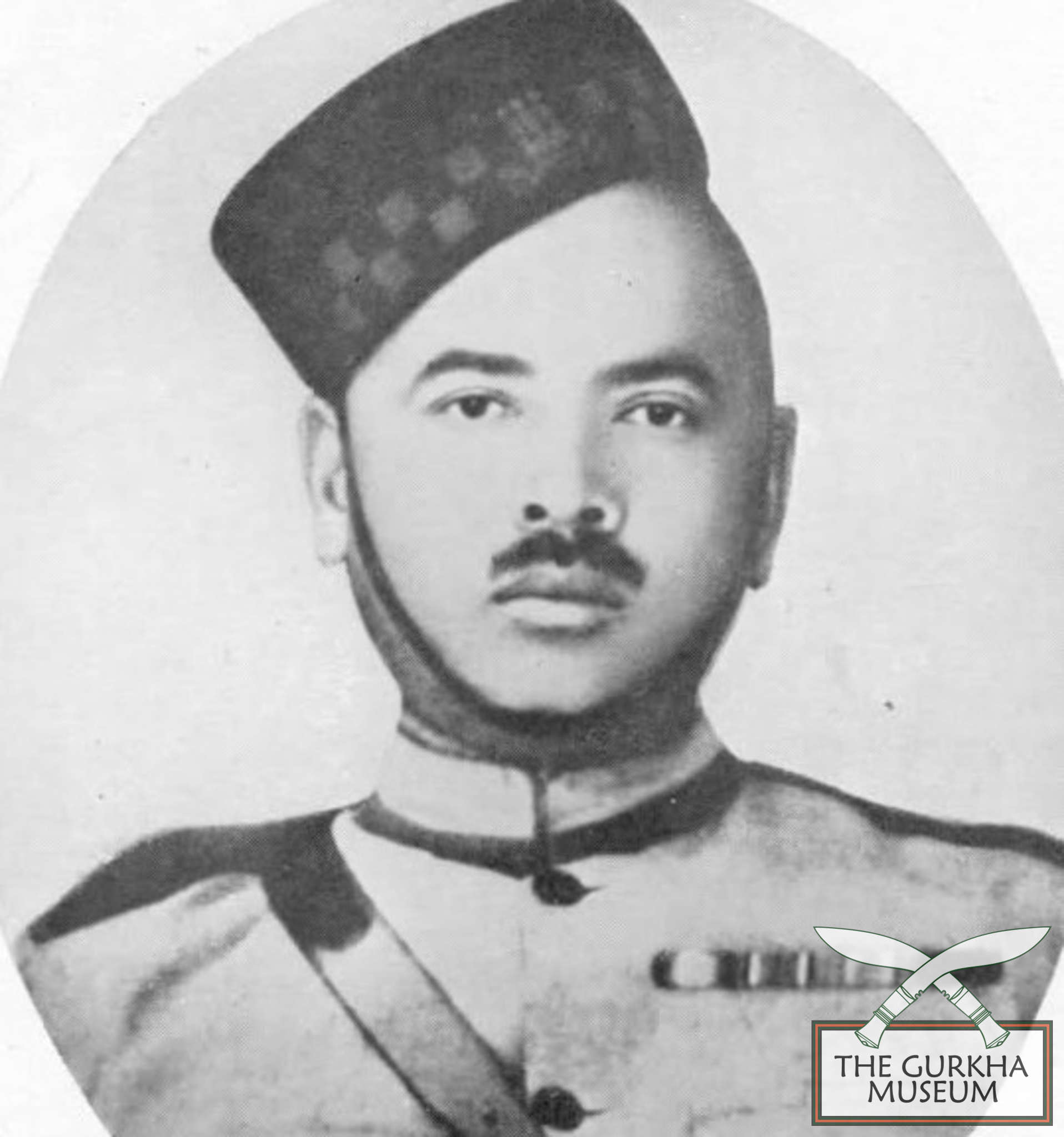
Subedar Major Hari Sing Bora enlisted in 1914 and fought on the Western Front during the First World War. He was posthumously awarded the Indian Order of Merit, the citation for which recognised his ‘outstanding personal example, courage, loyalty and fortitude unto death’.
During their long captivity, many PoWs at Changi maintained their morale by taking on classes and hobbies. Some soldiers would form amateur dramatics groups that staged plays and concerts, such as the ‘Old Water Mill Theatre’ group, who even produced handmade souvenir programmes.
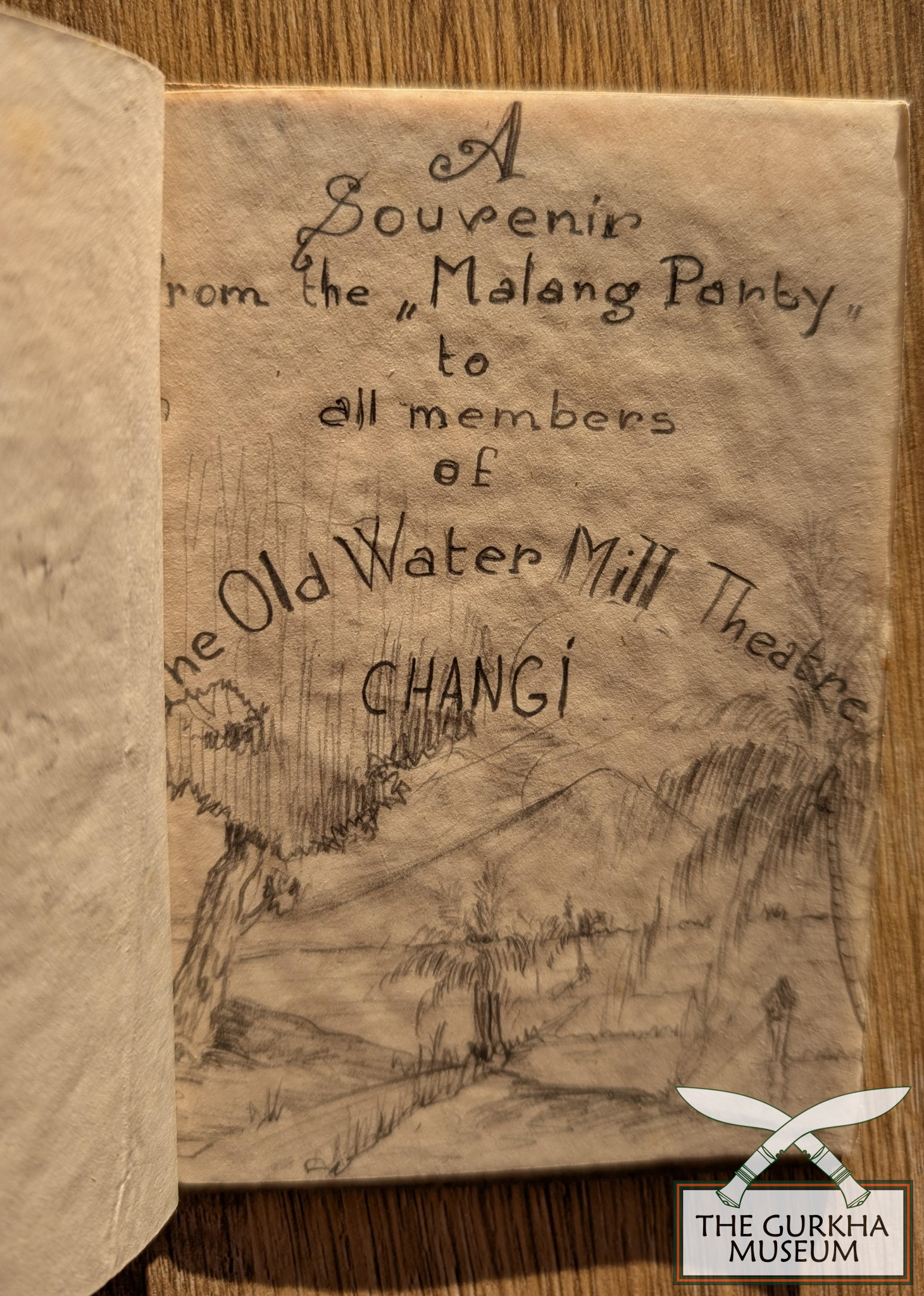
Frontispiece of a handmade programme produced by the Old Water Mill Theatre group. The programme is from the archive of Captain Lucas of 2/2GR who spent three years as a PoW, including a stint on the Burma-Thailand Railway.
Another PoW organisation was the ‘University of Changi’, which offered classes on subjects such as mathematics, engineering, history and art. For 2/2GR officer Peter Kemmis-Betty, respite was found in simple tasks such as farming and gardening.
Beyond Changi, Gurkhas were also held at Rangoon Jail and smaller camps around Burma. Like at Changi, conditions in Rangoon Jail were squalid, with the camp often being ironically referred to as the ‘Rangoon Ritz’.
Liberation
Japan’s surrender in August 1945 would not immediately spell freedom for the PoWs. Although many Allied prisoners were freed during the reconquest of Burma (with Rangoon Jail being liberated in May 1945), those held at Changi would have to hang on until September.
Rumours that the war was nearing its end began to filter into Changi on 11 August. Initially, many of the prisoners were ‘unmoved’ by the rumours, not wanting to get their hopes up. However, as news continued to emerge about ongoing negotiations between Japan and the Allies, the reality of their impending freedom began to sink in. Despite their obvious excitement, the following days were tense for the PoWs. It was unclear how their captors would respond to the news, or if they would even agree to surrender. Fortunately, tensions eased off over the following days, and the PoWs began to trickle out into the city. Another relief for the PoWs was an influx of Red Cross parcels.
Singapore was liberated by the 5th Indian Division on 5 September 1945. The first troops ashore were a company of the Punjab Regiment, who were followed shortly after by the 3rd Battalion, 9th Gurkha Rifles (3/9GR). The men of 3/9GR were eager to liberate their 2nd Battalion comrades being held in Changi. The division was met by cheering crowds, with the city’s Chinese residents happy to see an end to the Japanese occupation.
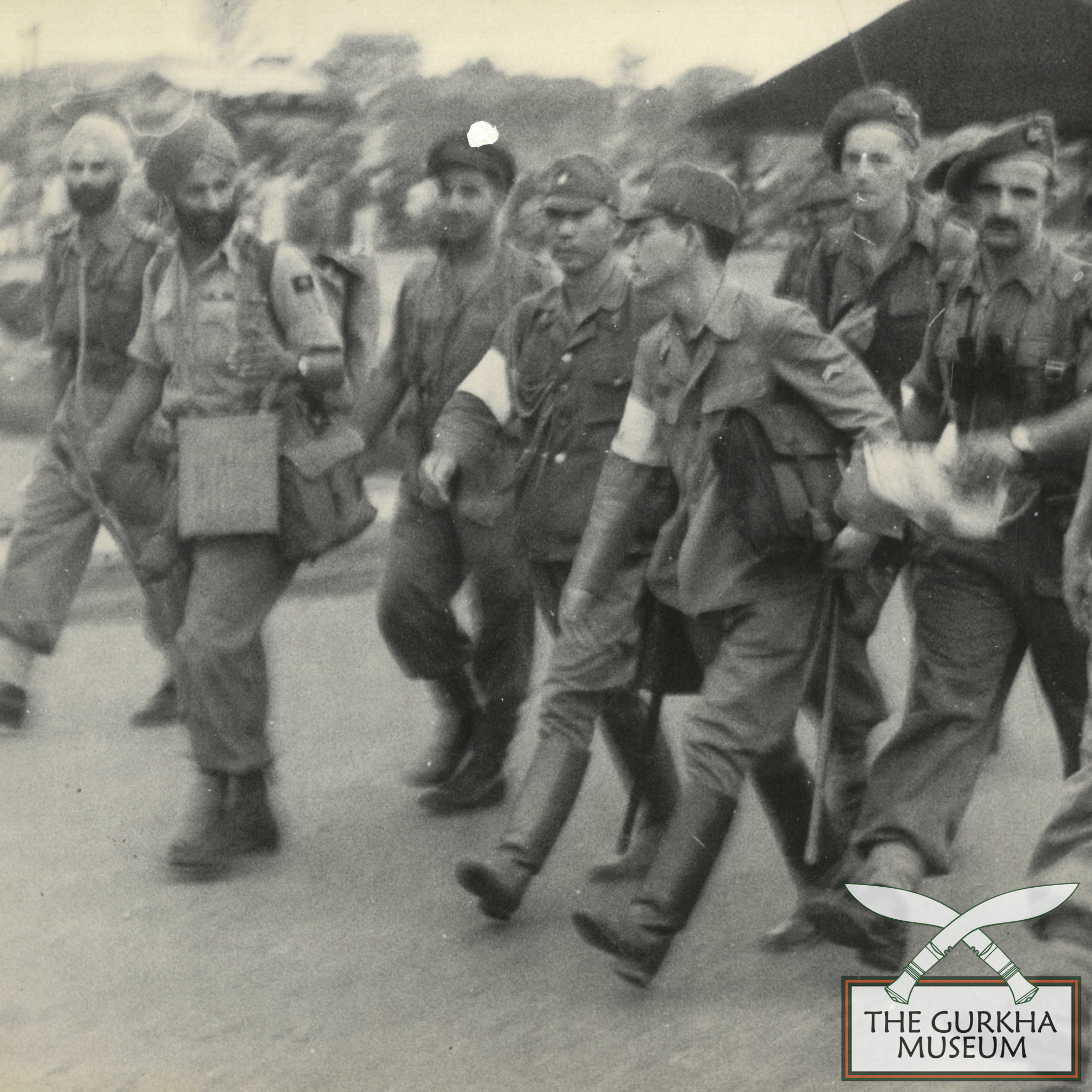
Men of the 5th Indian Division escorting surrendered Japanese officers during the liberation of Singapore, 5 September 1945.
A company of 3/9GR was sent to protect the now liberated camp. Captain Marshall of the Indian Army Medical Corps found their presence a comfort, writing in his diary: ‘A company of Gurkhas who did grand work in Burma have come to guard us. They are well armed with their kukris and Sten guns. We shall be safe’.
Upon arriving at the docks, 5th Division soldiers met parties of PoWs, and were shocked by their poor physical condition. The divisions history provides a vivid description:
‘Groups of British prisoners-of-war had wandered about the quayside looking pitifully thin. Some were dressed in ill-fitting uniforms with shorts too long or jackets too big. […] One man wore nothing but a Japanese loin cloth and he carried half a loaf of bread between his thin arm and his chest’.
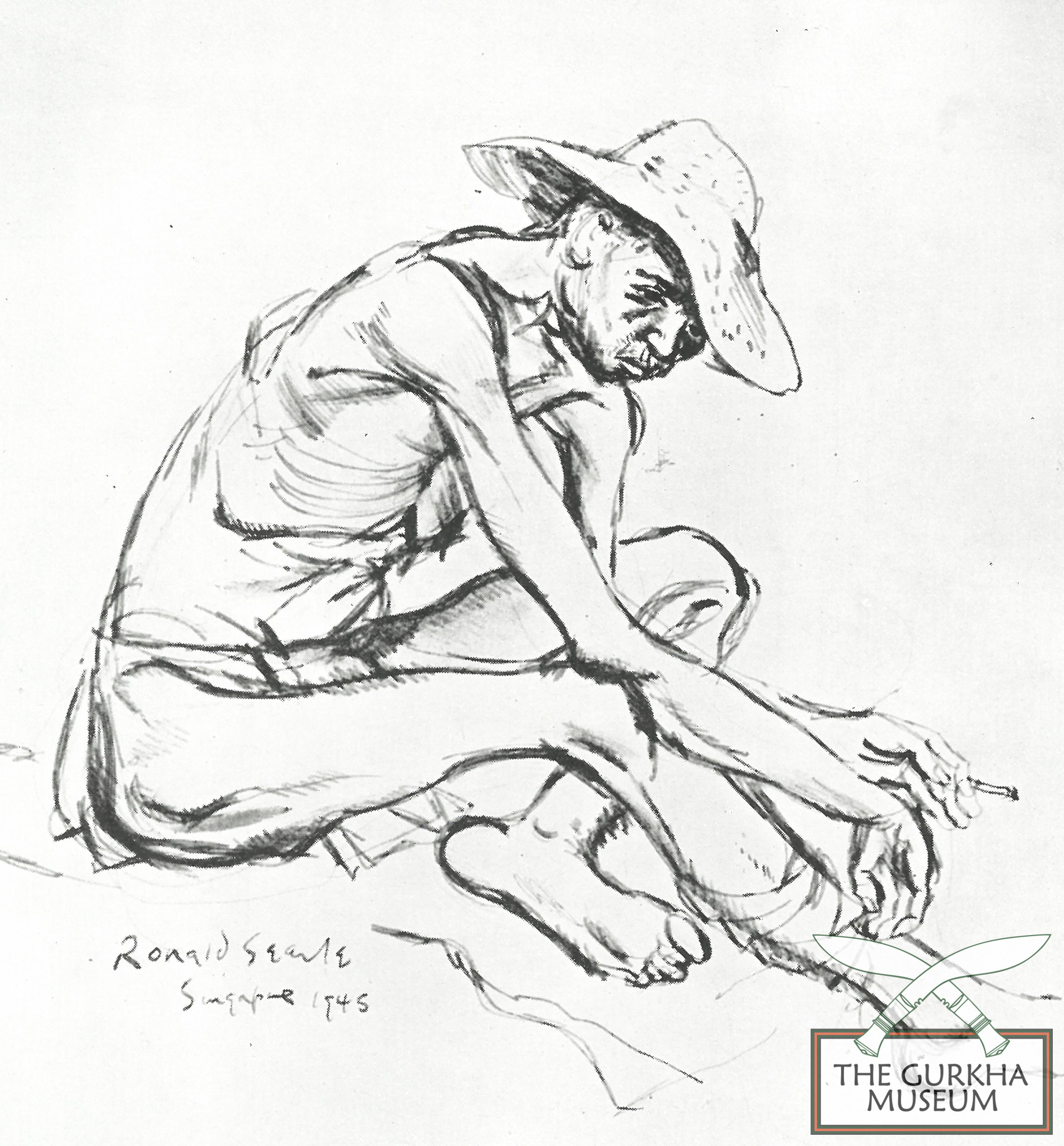
This man, sketched by Ronald Searle in 1945, is typical of the condition the prisoners were found in by the 5th Indian Division.
The worst affected PoWs were evacuated so that they could receive immediate medical attention. The remainder were moved into better accommodations around the city. Over the following days they began their rehabilitation. Benefitting from rest and a healthy diet, the men quickly began to regain their strength.
The reunion between the 2nd and 3rd Battalions of the 9th Gurkha Rifles was a touching event for those involved. Despite their ragged appearance, the Gurkhas of 2/9GR paraded smartly and received a special ‘shabash’ (words of congratulation) from their officers. Later, the British and Gurkha officers of the two battalions had a celebratory dinner in the rich surroundings of the Sultan of Johore’s Singapore residence.
A similarly emotional scene had occurred when the officers and men of 2/2GR were finally reunited. On 8 September, the British officers were able to visit the men at River Valley Road camp. 2GRs regimental history describes their meeting:
‘After three years and a half officers and men grasped hands with lumps in their throats and emotion ill-concealed. They were together again.’
By the end of September, the liberated Gurkha battalions began to leave Singapore, with most returning to Dehra Dun in India. Whilst at Dehra Dun, 2/2GR received a special visit from Field Marshal Sir Archibald Wavell, Viceroy of India. After his inspection, Field Marshal Wavell shook hands with the battalion’s Gurkha officers. Among them was Subedar Major Kalu Sing Chhetri, who survived his captivity unbroken.
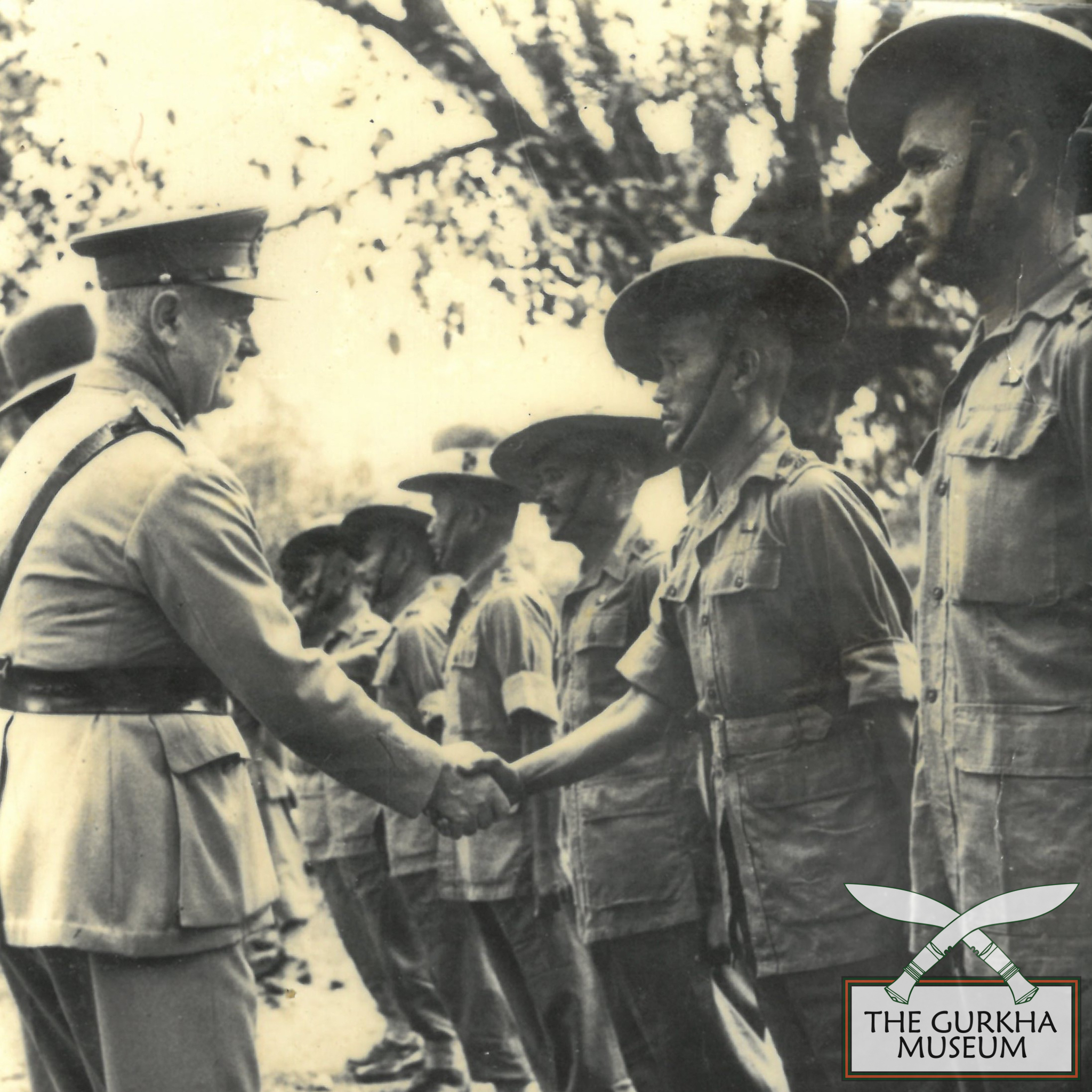
Field Marshal Wavell shaking hands with 2/2GRs Gurkha officers, among whom is Subedar Kalu Sing Chhetri.
Although there is no record of the specific number of Gurkha casualties, it is known that over 800 Allied servicemen died during their imprisonment at Changi. Despite this sad loss of life, Changi Jail can be remembered as an example of courage, endurance and comradeship in the face of difficult circumstances. It is also an example of the incredible resilience of Gurkha soldiers, exemplified by men such as Hari Sing Bora and Kalu Sing Chhetri.