Harkbir Thapa: Mountaineer, Adventurer, Soldier

Harkbir Thapa: Mountaineer, Adventurer, Soldier

Introduction

In recent years, Gurkhas have gained a reputation as outstanding mountaineers. In 2019, Gurkha veteran Nims Purja made headlines when he climbed 14 of the world’s highest peaks in just 6 months. In 2023 another Gurkha veteran, Hari Budha Magar, set a record when he became the first double above-knee amputee to summit Mount Everest. However, the Gurkha mountaineering tradition goes back much further, beginning in the 19th century.

One of the greatest Gurkha mountaineers of that era was Harkbir Thapa of the 5th Gurkha Rifles. Harkbir’s service is highly noteworthy. Not only was he an experienced mountaineer and a long serving Gurkha officer, but he was also one of the first Gurkha soldiers to visit the United Kingdom.

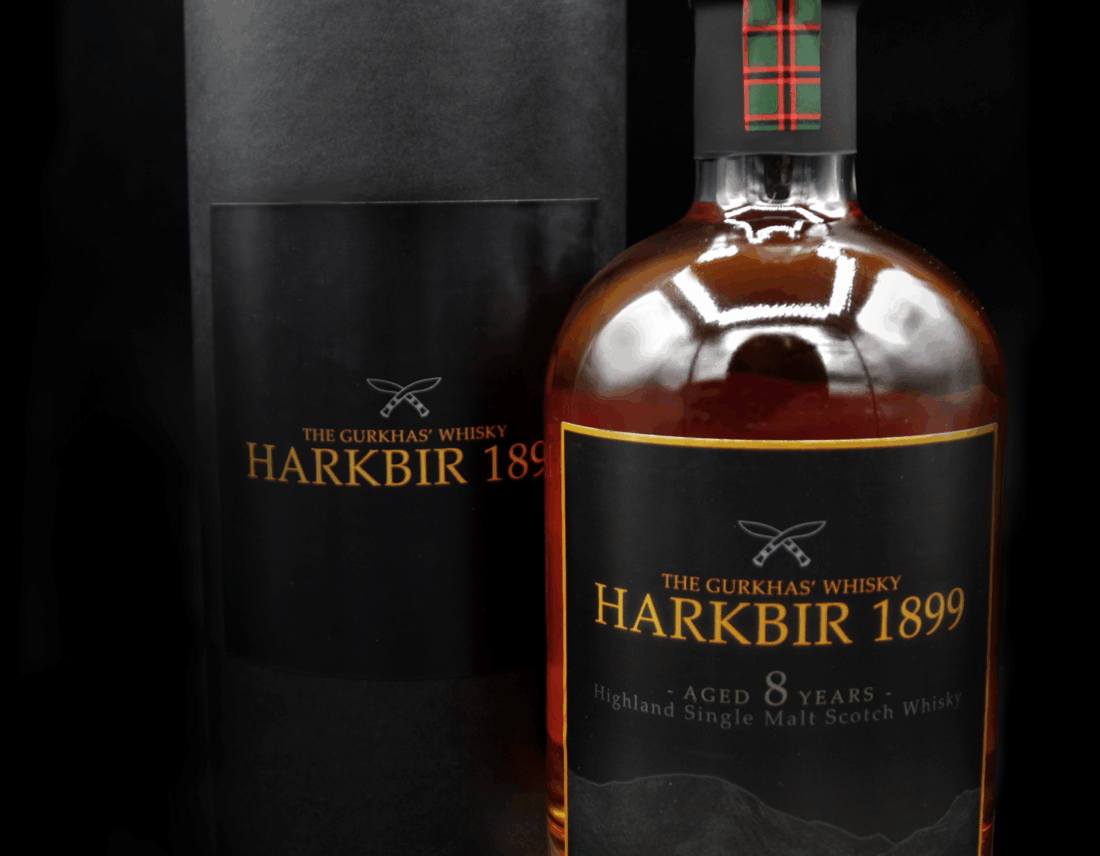
In 2021, the Gurkha Museum released its signature scotch Whiskey, Harkbir 1899, in his honour. The name is a reference to the day, in 1899, when Harkbir ran up and down Glamaig Hill in 55 minutes, setting a hill running record that stood unbroken for almost a century.

But Harkbir’s run up Glamaig Hill was just one event in a life full of heroism and adventure. To properly honour Harkbir, it is only fitting to tell his full story.

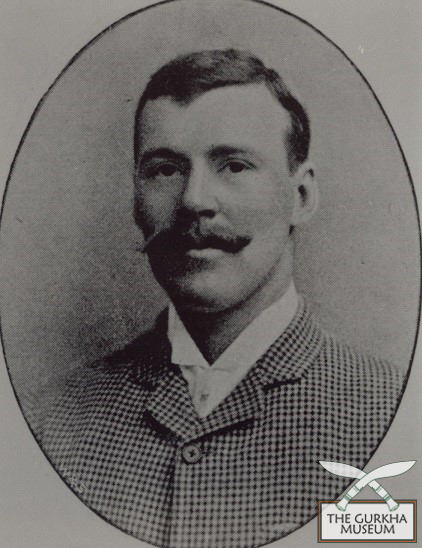
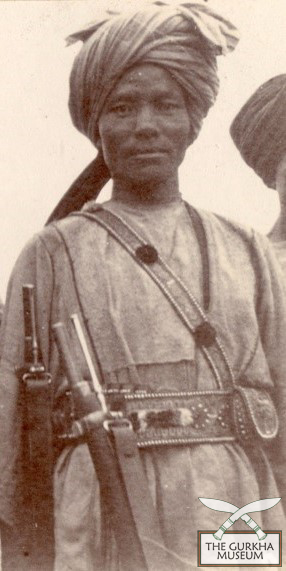
Harkbir Thapa, c.1900.


Gurkha Soldier

From his dates of service, it is likely that Harkbir was born around 1870. In 1888, Harkbir enlisted in the 5th Gurkha Rifles, beginning his 29 years of service with the Gurkhas.

His life comes into view more clearly in the 1890s, during his service on the North West Frontier of India. By 1891, Harkbir was serving in the 1st Battalion, 5th Gurkha Rifles (1/5GR), where he was orderly to Lieutenant John Manners-Smith. In this period, orderlies acted as the chief attendant to a British Gurkha officer. This could include duties such as tending to an officer at meals and aiding with his personal errands. Orderlies would also accompany their officer into battle.

Lieutenant John Manners-Smith.

In November 1891, the British Indian Army entered into conflict with the kingdoms of Hunza and Nagar, in what is now Pakistan. The conflict began when these kingdoms opposed British efforts to establish roads and telegraph lines through the region. After the British ignored warnings to leave their territory, Hunzan and Nagar warriors blockaded the roads.

In response, a column of approximately 1000 British Indian Army troops, which included 200 Gurkhas of 1/5GR, entered the region by December. Over the coming weeks they would face a series of clashes with Hunzan and Nagar warriors, principally at Nilt Fort and the Thol cliffs. It was at Thol that both Harkbir and Manners-Smith would distinguish themselves.

The attack on the Thol cliffs took place on the night of 19/20 December 1891. Leading 50 Gurkhas, Lt. Manners-Smith (accompanied by Harkbir) scaled the treacherous route up the Thol cliffs, taking cover where the enemy sangars were unable to spot them. Once in position, the attackers waited for daylight.

The fighting commenced at 8am. Remarkably, the Gurkhas got to within only 60 yards of the sangars before the enemy spotted them. But once they did, the warriors began to hurl rocks down at the attackers as they scaled the last few yards of the cliff. Finally reaching level ground, Manners-Smith and a party of Gurkhas rushed the enemy. Reaching the nearest sangar, Harkbir entered it and cleared out the enemy fighters.

Resistance crumbled as the remainder of the Gurkhas arrived, quickly dislodging the enemy. For his coolness and leadership during the attack, Lt. Manners-Smith was awarded the Victoria Cross, the British military’s highest gallantry award. Harkbir’s bravery was also recognised, and he was awarded the Indian Order of Merit.

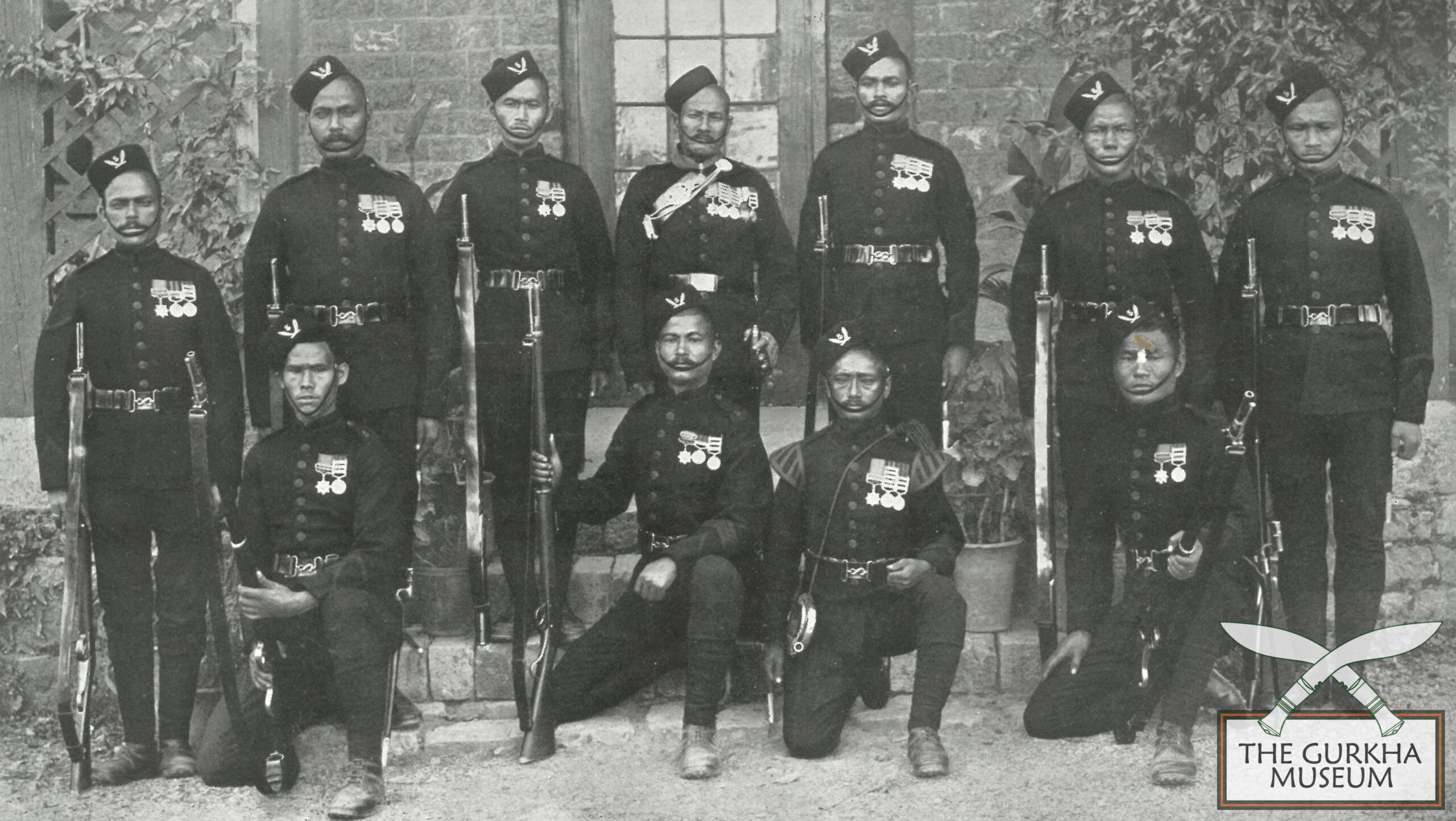
5th Gurkha Rifles Indian Order of Merit recipients, photographed in 1899. Harkbir is on the back row, 2nd from the right.

Gurkha Mountaineer

Harkbir’s mountaineering adventures began in 1890, when he joined Colonel Stewart of 5GR on a climbing expedition in the Pamir Mountains in Central Asia. In 1892 Harkbir was one of four Gurkhas selected to join the expedition of Martin Conway into the Karakoram Mountains, on what is now the China-Pakistan border. Harkbir was personally selected by Lieutenant Charles Bruce, a 5GR officer and acclaimed mountaineer. This was the beginning of a long friendship between Bruce and Harkbir.
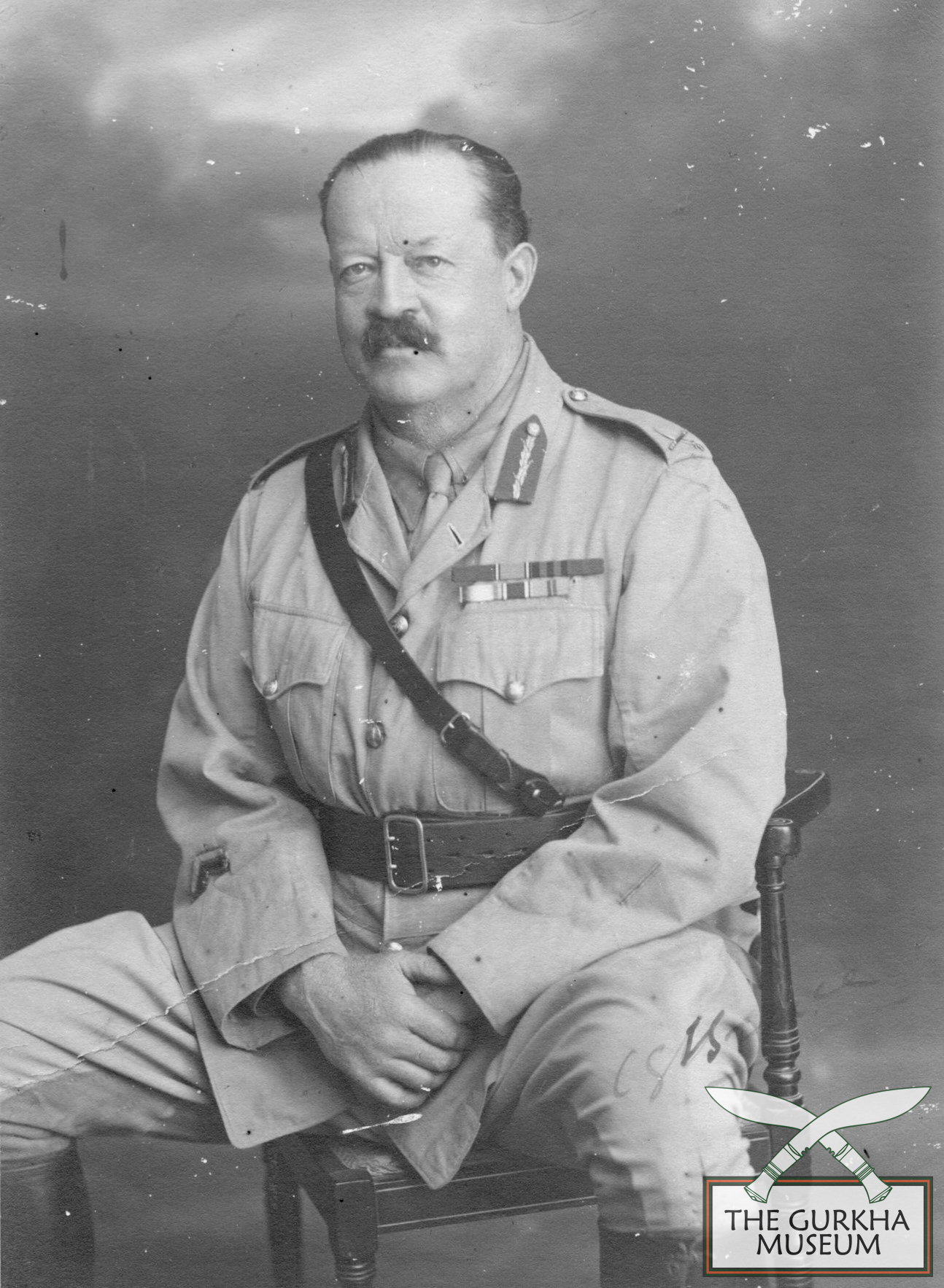
Charles Granville Bruce (1866-1939) photographed later in his career. He would rise to become a Brigadier General, and led two expeditions to Mount Everest in the 1920s

Setting out in April 1892, the expedition surveyed the Hispar glacier and the traversed the Nushik La pass. They also summited Baltoro Kangri, which rises to a staggering 23,000 feet. Whilst climbing Pioneer Peak, Harkbir had a close brush with death when a cutting in the ice gave way under his feet, causing him to slide down an almost vertical ice shelf. Fortunately, Martin Conway had a good grip on Harkbir’s rope and managed to hold onto him. Coming to a sudden stop, Harkbir ‘swung round with the rope, like a weight on the end of a pendulum’. Shaking off the initial shock, Harkbir carefully worked his way back up to the rest of the team
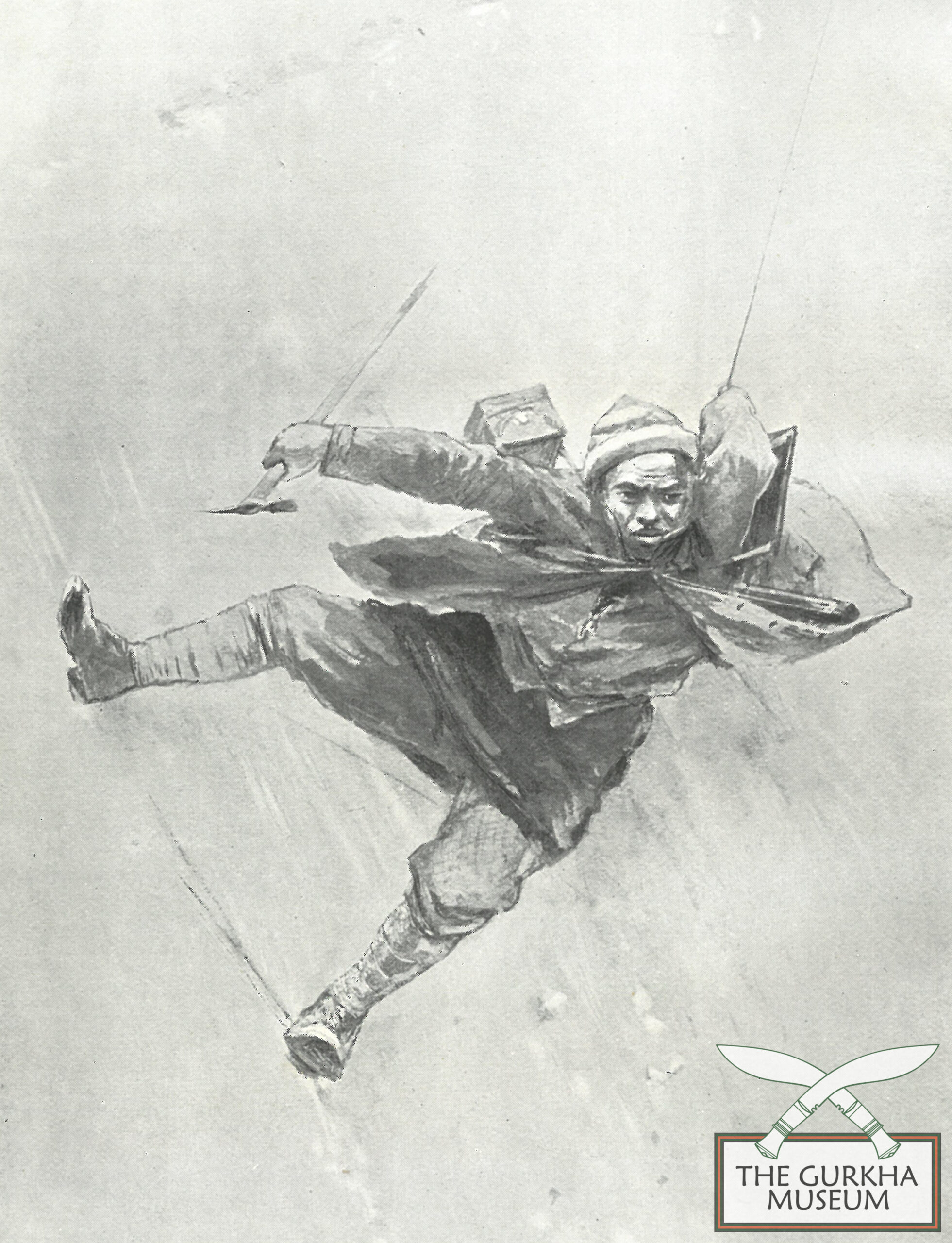
Harkbir’s brush with death on Pioneer Peak as depicted by Arthur McCormick, who was an artist on the expedition. Source: Climbing in the Himalayas by W. M. Conway.

By the end of the expedition, the team had mapped 2,000 square miles of the region. During their explorations in the Karakoram, a closeness developed between Bruce and Harkbir when the former was injured in a fall, hurting his back and badly spraining his leg. Over the next several days, Harkbir diligently tended to Bruce, who credited his recovery to Harkbir’s care.

For the next several years, Harkbir and Bruce were constant companions. Harkbir climbed with Bruce in the Kashmir Mountains, and in 1895 joined Bruce and his wife on a trek through the Khagan valley.

In 1897, Harkbir was chosen to join the ‘Gurkha scouts’, a specialised detachment raised by Bruce and Captain Lucas of the 2nd Battalion, 5th Gurkha Rifles. These Gurkhas were specially trained for ‘work on the steepest hill-sides, and selected for their wiry physique, fleetness of foot, and skill as marksmen’. Harkbir and the Gurkha scouts were heavily employed during the Tirah Campaign of 1897-1898, seeing extensive action against Afridi tribesmen.

The Gurkha scouts on parade, c.1897.

In 1899, Harkbir’s friendship with Bruce brought him to Europe. By this time, Harkbir had been promoted to Havildar (sergeant). After a period in London and a trek around the Welsh hills, Bruce took Harkbir to Switzerland.

Whilst in Switzerland, the pair trekked around the Alps and made an attempt on Mont Blanc, the second highest peak in Europe. In August they returned to Britain and travelled to Scotland, hiking in the Highlands and on the Isle of Skye.

It was at Skye that Harkbir performed his famous hill running feat. At Sligachan Inn, an argument broke out between Bruce and a Scottish laird, Macleod of Macleod, which resulted in a bet. Macleod did not believe that earlier in the day Harkbir had run to the top of Glamaig hill and back in an hour and a quarter – a distance of two miles across open moorland to the foot, and a rise of 2817 feet to the summit.

Determined to defend his achievement, Harkbir took off up the hill barefoot. This time, he returned within the hour. Reaching the summit in only 37 minutes, he took just a further 18 to return to the inn, knocking 20 minutes off his previous time. It took a professional fell runner in running shoes, nearly a hundred years later, to shave five minutes off the time set in 1899.

Sadly, their trip around Europe would be the last that the two men would take together. Harkbir’s abilities had not gone unnoticed, and he was rapidly becoming a highly relied upon man in his regiment. After 1900, Harkbir’s duties meant that he was unable to accompany Bruce on expeditions.

Nevertheless, Bruce always remembered Harkbir fondly. In his 1934 autobiography, Himalayan Wanderer, Bruce wrote at length about his old friend. It is largely due to his writings that we know so much about Harkbir’s life.
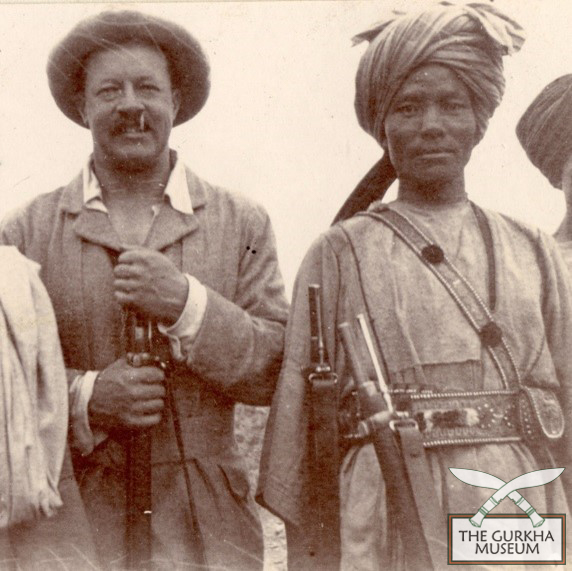
Bruce and Harkbir, photographed together in the 1890s.
Gurkha Major

Between 1900 – 1914, Harkbir continued to render good service to his regiment, receiving a steady series of promotions. By 1907 he was a Subedar Major, the highest rank a Gurkha of that period could achieve. In 1911, Harkbir was among a group of 5GR Gurkha officers selected to represent the regiment at King George Vs Coronation Durbar in Delhi.

In 1914 Harkbir once again travelled abroad, this time for war. Britain had entered the First World War in August 1914, initially against the German Empire. In November 1914, the Ottoman Empire (centred in what is now Turkey) entered the conflict on the side of Germany. The Ottomans quickly moved to cut off access to the Suez Canal in Egypt, which was a vital route for British shipping. In December 1914, 1/5GR was committed to a force that was defending the Canal from the Ottomans.

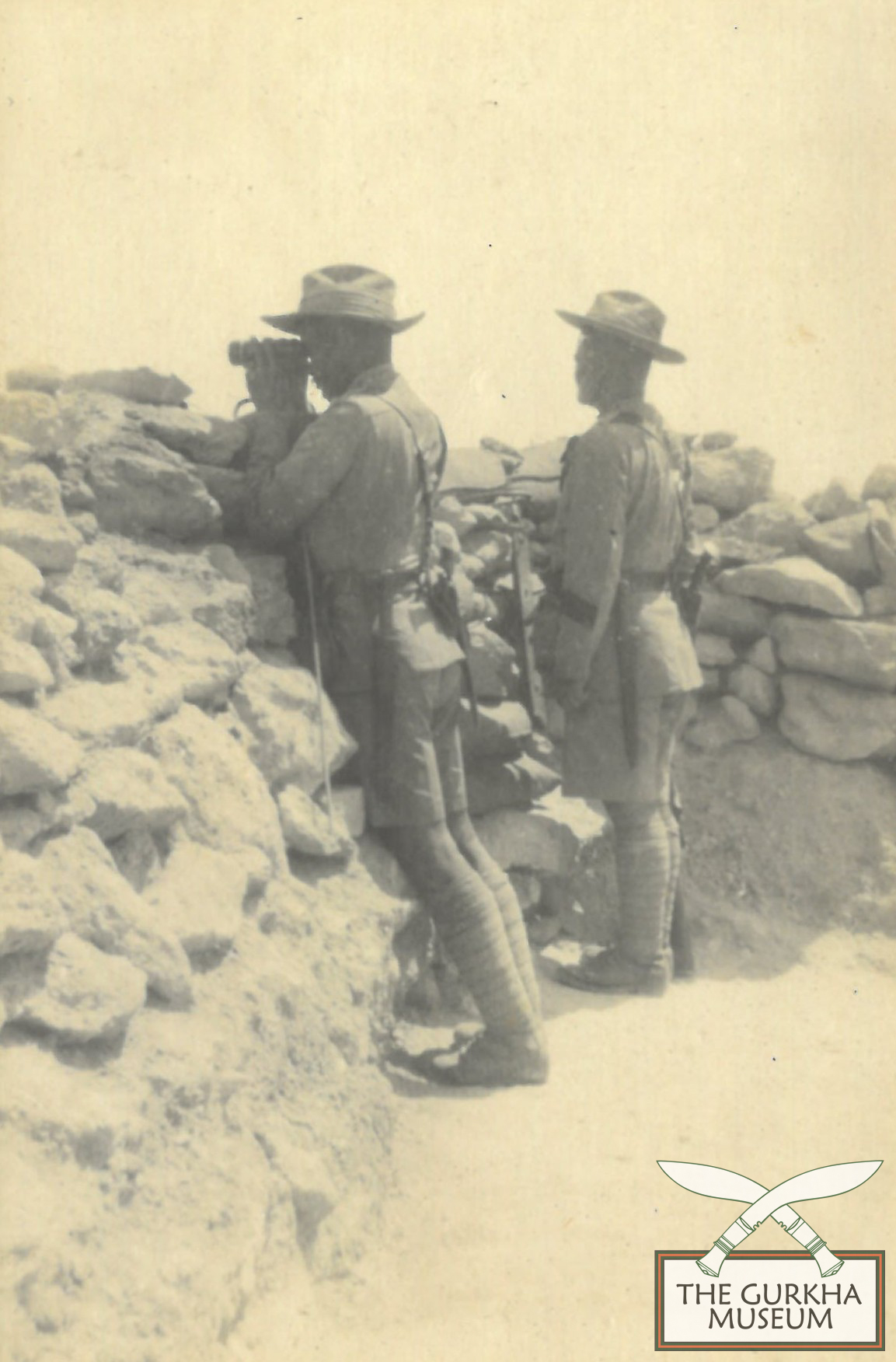
A 1/5GR outpost on the Suez Canal defences, March 1915. The man with the binoculars is observing Ottoman movements.

On the night of 30/31 January, evidence of Ottoman patrols near 1/5GRs outposts prompted an ambush party to be put together, led by the redoubtable Harkbir.

Crawling out from their defences after dark, Harkbir and his men lay in wait for the enemy. At midnight, five Ottoman soldiers passed Harkbir’s position. Opening fire, Harkbir’s party wounded and captured one Ottoman and scattered the remainder. In their panic, the Ottomans abandoned their equipment and dynamite, which the Gurkhas brought back with them.

In May 1915, it was decided that 1/5GR would be sent to reinforce the Gallipoli Campaign. The campaign had begun on 25 April 1915, when British and Commonwealth troops landed on the Gallipoli Peninsula, hoping to break through to the Ottoman capital of Constantinople (now Istanbul).

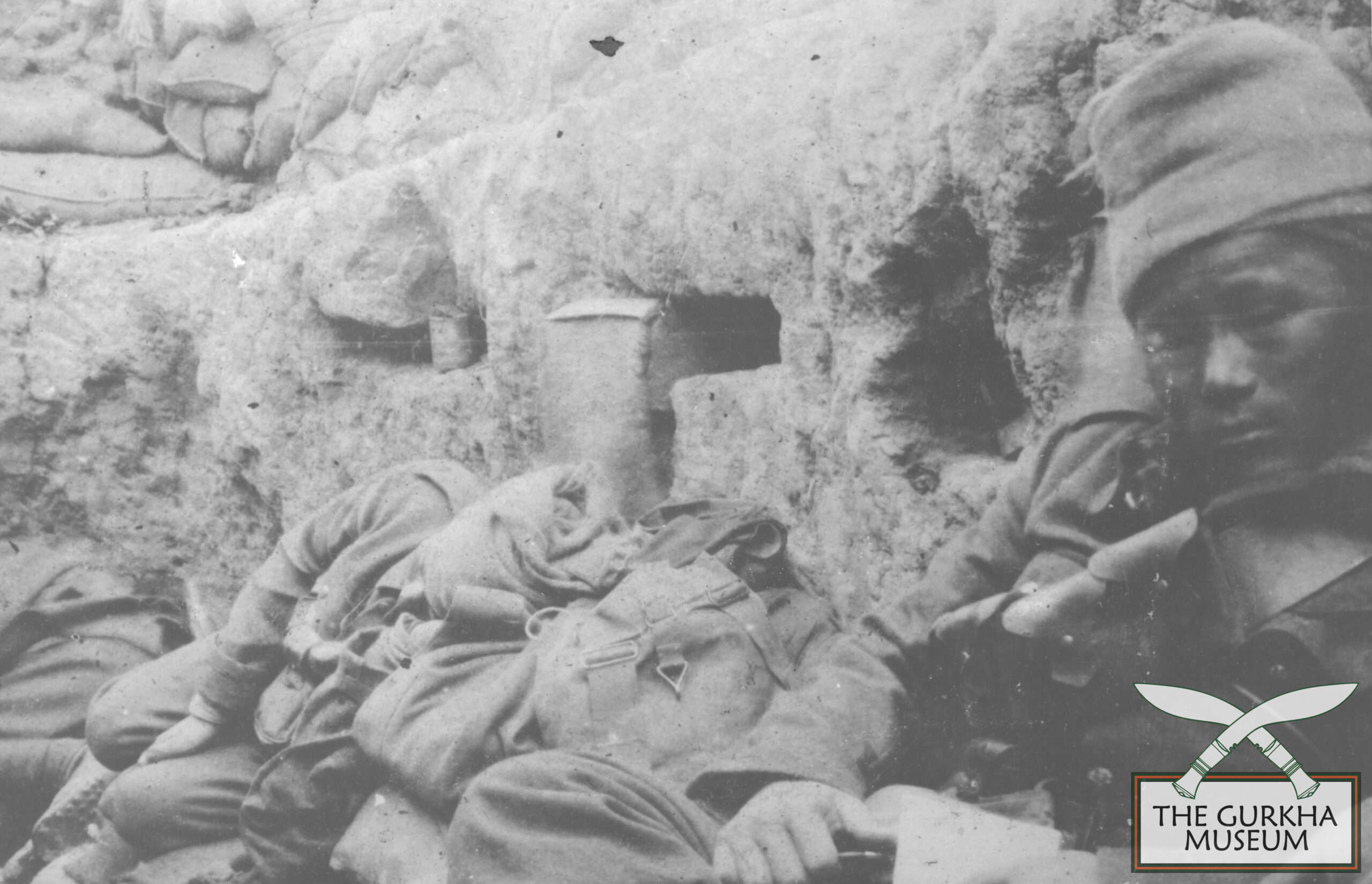
Men of the 6th Gurkha Rifles sleeping in a frontline trench, Gallipoli, c. June 1915.

1/5GR landed on the peninsula on 3 June. Disembarking at ‘V’ Beach, the Gurkhas constructed dugouts in the cliffs to give them cover from enemy shelling. At the same time, other Indian Army troops (including the 6th Gurkha Rifles) were attacking the Ottoman frontline. This attack was meeting little success, and on 4 June 1/5GR was called upon to join the battle.

Attacking Ottoman positions on the cliff tops, the Gurkhas passed over open ground under a hail of machine gun fire. By this point in the battle the Ottomans had reinforced their positions, and had roughly 8000 troops in the area. Consequently, 1/5GRs attack was unable to turn the tide of the battle, with the Gurkhas enduring bitter and costly fighting. Successive assaults failed to breakthrough, and the battalion was withdrawn after nightfall. In one afternoon of fighting, 1/5GR had suffered 33 killed and 96 wounded.

Harkbir was among the casualties, having been shot through the foot. On 5 June the battalion’s wounded, including Harkbir, were evacuated to hospitals in Malta and Egypt. It doesn’t seem that Harkbir ever returned to active service. He last appears in the Indian Army Lists in 1917, indicating that he retired from service that year. Whether his retirement was due to age, or because of lingering effects from his wound, is not known.

Following the end of his service, Harkbir’s life is harder to track. Although we do not know his precise date of death, evidence suggests that he was still alive in the late-1930s, though likely passed away before 1940.

Beyond being a brave soldier and an accomplished sportsman, Harkbir was also remembered for his kindness. Martin Conway, who had greatly relied on Harkbir during his 1892 expedition, recounted how Harkbir had fussed over the bearers and orderlies. Whenever he noticed that a bearer was struggling, Harkbir would add their load to his own. Conway also recalled how Harkbir took away his tents waterproof groundsheet so that an ill bearer could rest more comfortably.

But despite the many adventures of his life, at his core Harkbir was a soldier. Finishing his recollections, Conway concluded that Harkbir ‘did his duty, and expected other men to do theirs’.

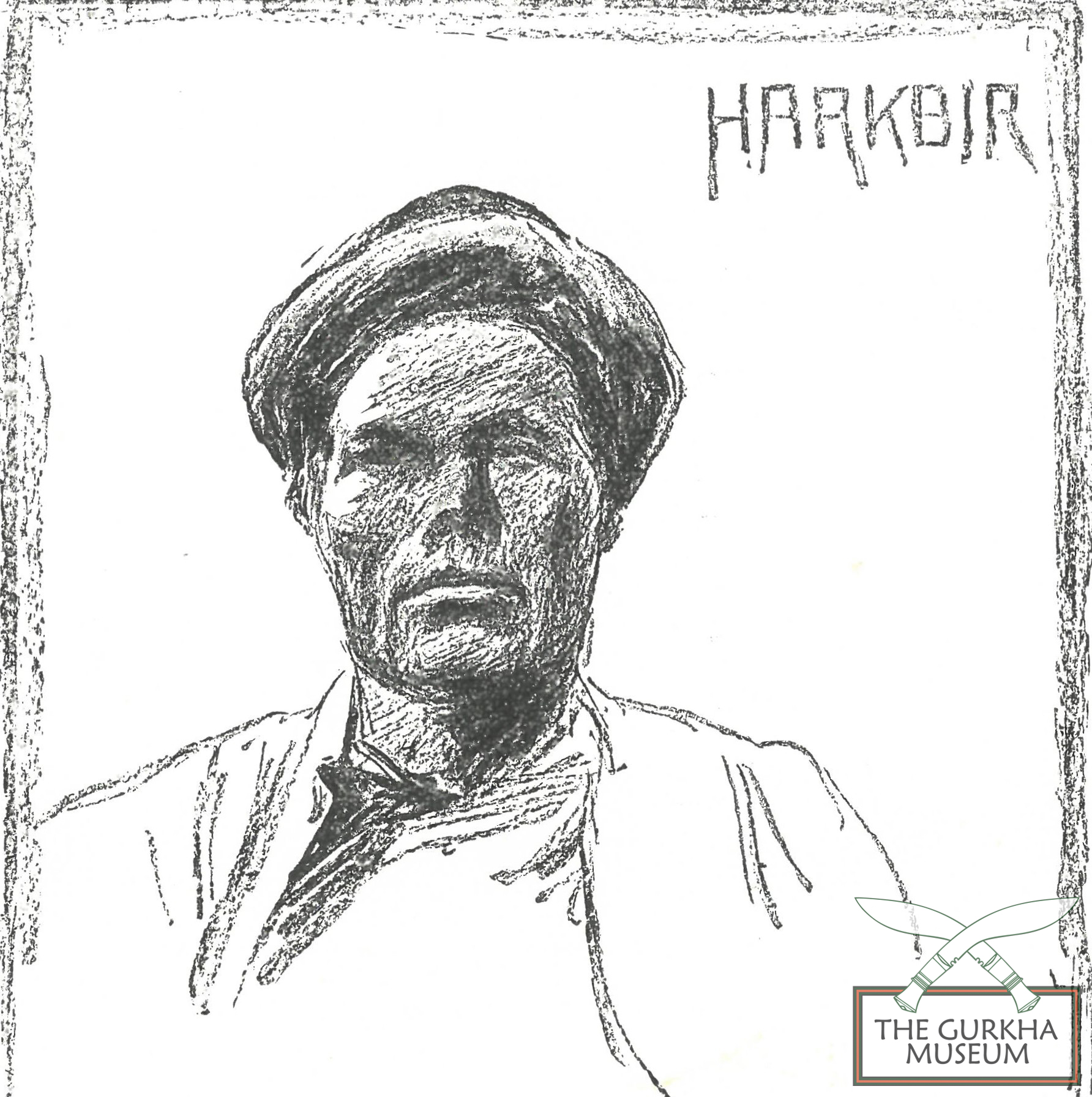
A sketch of Harkbir, drawn by Arthur McCormick in 1892. Source: Climbing in the Himalayas by W. M. Conway.

Gurkha Museum Trust's Harkbir 1899

The Gurkha Museum trust has honoured his incredible legacy and achievement with our whiskey, Harkbir 1899, available for purchase in our shop

© The Gurkha Museum Trust Winchester - Registered Charity Number 1169920 (formerly 272426)