Breaking The Mareth Line
Despite their success at El Alamein, Allied fortunes in Tunisia were mixed for the first several months. The Germans had thwarted a British advance towards the capital city of Tunis, and in February 1943 American forces were badly mauled at the Battle of the Kasserine Pass.
By the beginning of March 1943 however, the tide was beginning to turn. A last-ditch offensive by Rommel had failed, and continued attacks on Axis shipping routes were rapidly draining them of vital supplies, reinforcements and fuel. With the outcome of the campaign in little doubt, Adolf Hitler ordered Rommel, seen by the German public as one of their star generals, to be withdrawn back to Europe to avoid the blame of impending defeat. He was replaced by General Hans Jurgen von Arnim, who was given the grim task of taking over a failing campaign.
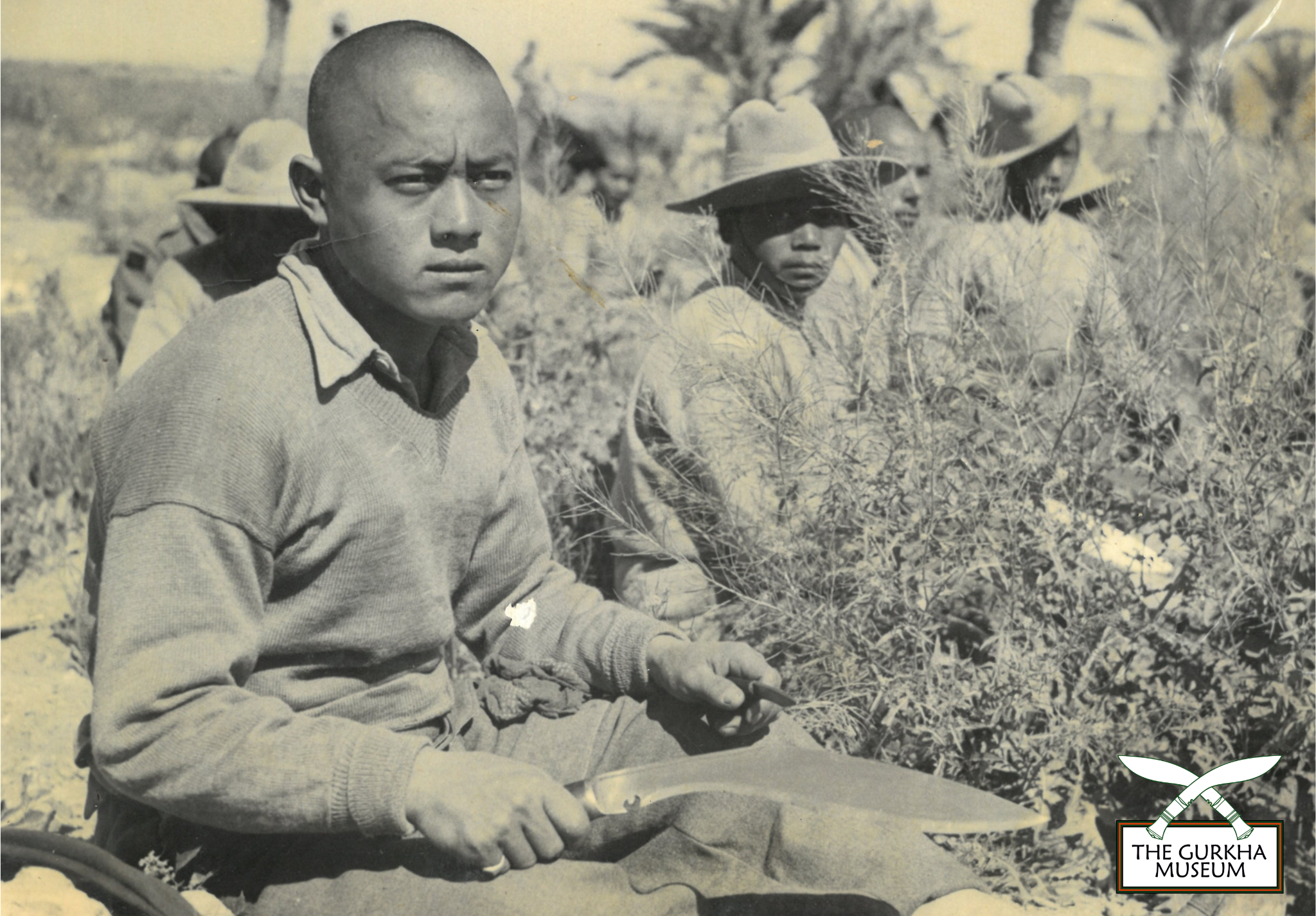
In mid-March, the remaining German and Italian forces in Tunisia placed themselves behind the Mareth Line, a string of fortifications originally constructed by the French. Ahead of the main attack, the 1st Battalion, 2nd Gurkha Rifles (1/2GR) were tasked with probing enemy defences in the nearby Matmata hills.
On the night of 17 March, ‘B’ Company of 1/2GR, under the command of Captain Ramsay-Brown, carried out a reconnaissance mission to locate enemy machine gun positions. Camouflaged with grass and leaves, the Gurkhas set out into the night and walked four miles in search of the enemy. After finding a German position, a Gurkha platoon exploited a low mist to creep up close to the enemy before pouncing into action. The skirmish that followed was described in the 2GR regimental history:
‘Absolute bedlam reigned. The Germans stood their ground and the Gurkhas, who throughout used only bayonets and khukuris, dashed to the close amidst the “rip, rip” of German squeeze guns, the noise of stick grenades and the gurgle of men being killed’.
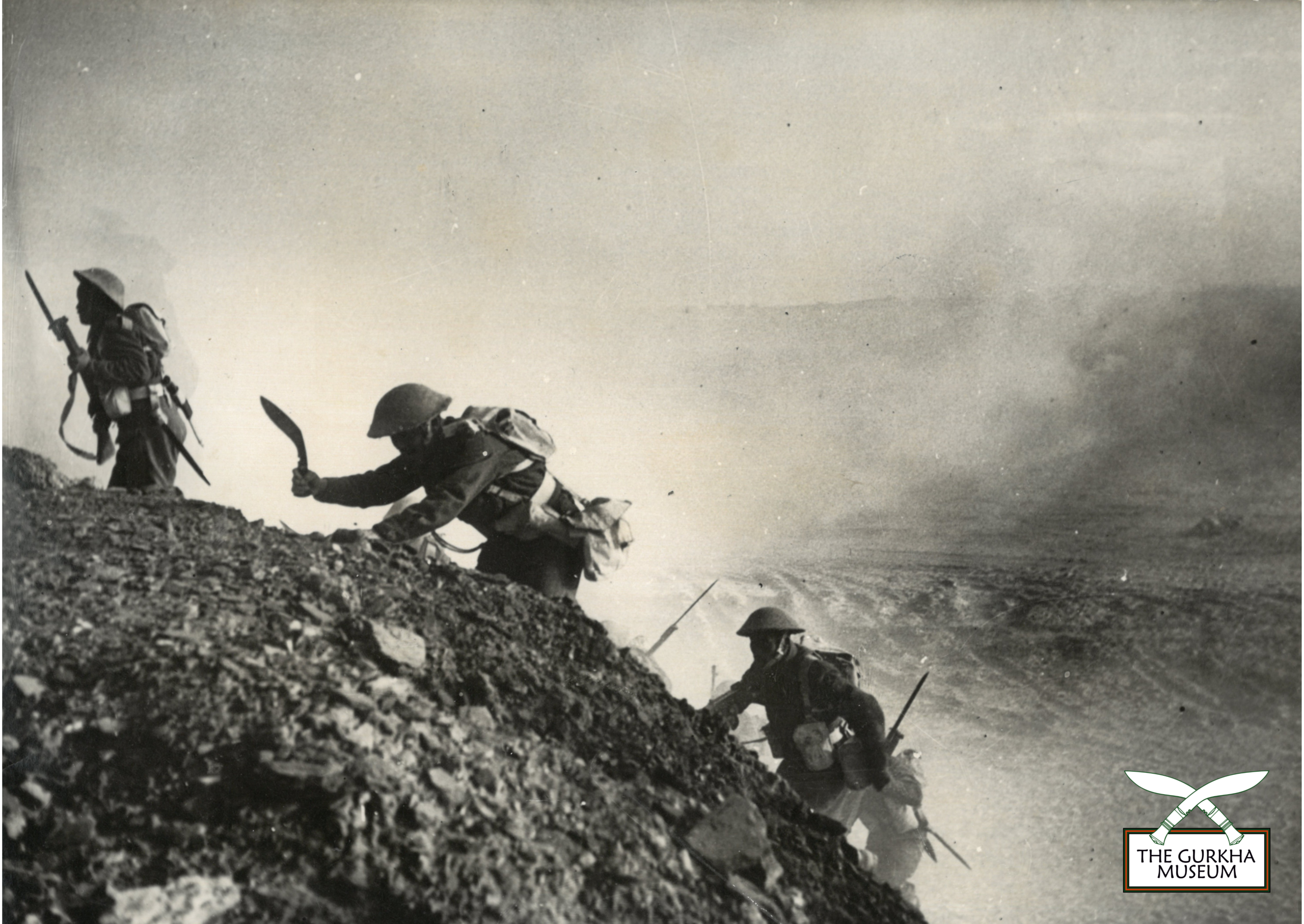
A posed shot of Gurkhas advancing up the steep terrain around the Mareth Line, Tunisia, March 1943.
After 5 minutes of brutal hand-to-hand fighting, 15 Germans had been killed for the cost of 4 Gurkha casualties. The remainder of the German defenders had fled.
Elsewhere, the 1st Battalion, 9th Gurkha Rifles (1/9GR), part of the 5th Indian Brigade, found themselves on a probing mission of their own. They were attempting to open the way through the Hallouf Pass, which would shorten Allied supply lines by 150 miles.
Although enemy opposition was light, the Gurkhas found the way heavily mined. Even worse, the mines were made of plastic or wood, rendering mine detectors useless. 1/9GR suffered its first officer fatality of the war when Lieutenant Wilkinson’s vehicle struck a clutch of mines, killing him instantly.
With the Gurkhas providing cover, Indian Army engineers got to the painstaking task of mine clearance, prodding their way forward with their bayonets. Eventually, the way was cleared and the 5 Indian Brigade continued its journey across the steep ridges of the pass. Although some units had brief skirmishes with the Italian rearguard, the Hallouf Pass was gained without heavy fighting.
The Gurkhas would not have such luck at their next objective.
The Battle of Wadi Akarit
To allow the Allies to wheel round behind the Axis forces, the 4th Indian Division was directed to make a night assault to take a feature known as the Fatnassa heights. 1/2GR was tasked with capturing several objectives, notably Point 275 and the massif around Rass ez Zouai. The attack was meticulously planned, with a sand model being constructed of the feature so that all British and Gurkha officers knew exactly what they were expected to do.
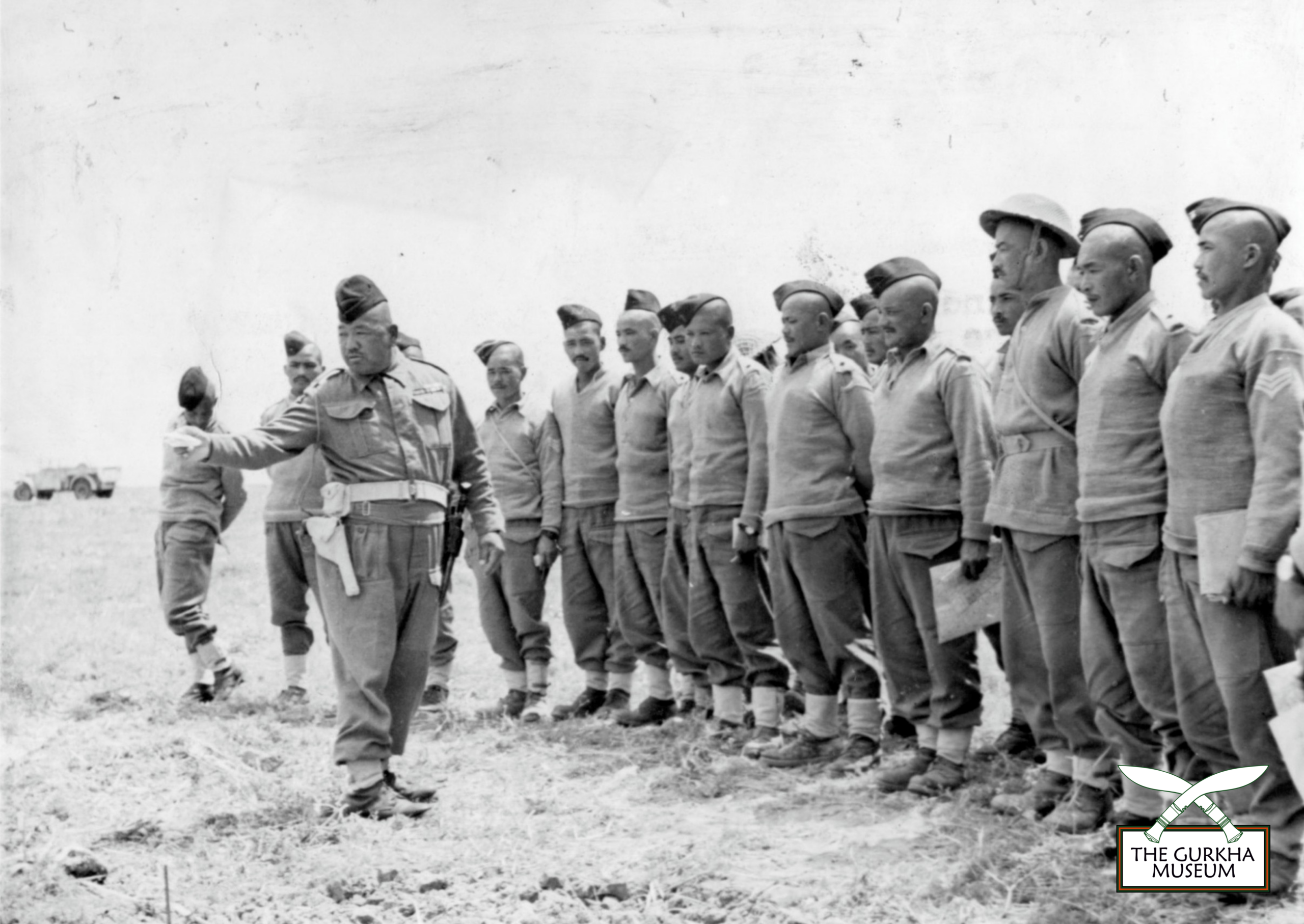
Using a sand model as reference, Subedar Major Narbahadur Gurung briefs Gurkha NCOs on the coming attack on the Fatnassa Heights.
The attack commenced on 5 April. Laden with weapons and equipment, the Gurkhas trudged toward their jumping-off positions under a new moon. The fighting began at 11.30pm, with ‘D’ Company leading the charge.
Two sections of ‘D’ Company were led by Subedar Lalbahadur Thapa. He led his men up an escarpment, using the shadows to surprise and dispatch German sentries. But an attack of this scale could not remain undetected for long, and Lalbahadur and his men quickly found themselves being raked by heavy fire.
Undeterred, Lalbahadur rushed ahead and charged the forward enemy positions, killing several Germans with his khukuri. His men followed close behind, fighting desperately to neutralise the enemy. Their tenacity paid off, and Lalbahadur and two other Gurkhas soon reached the top of the escarpment, putting the remaining defenders to flight.
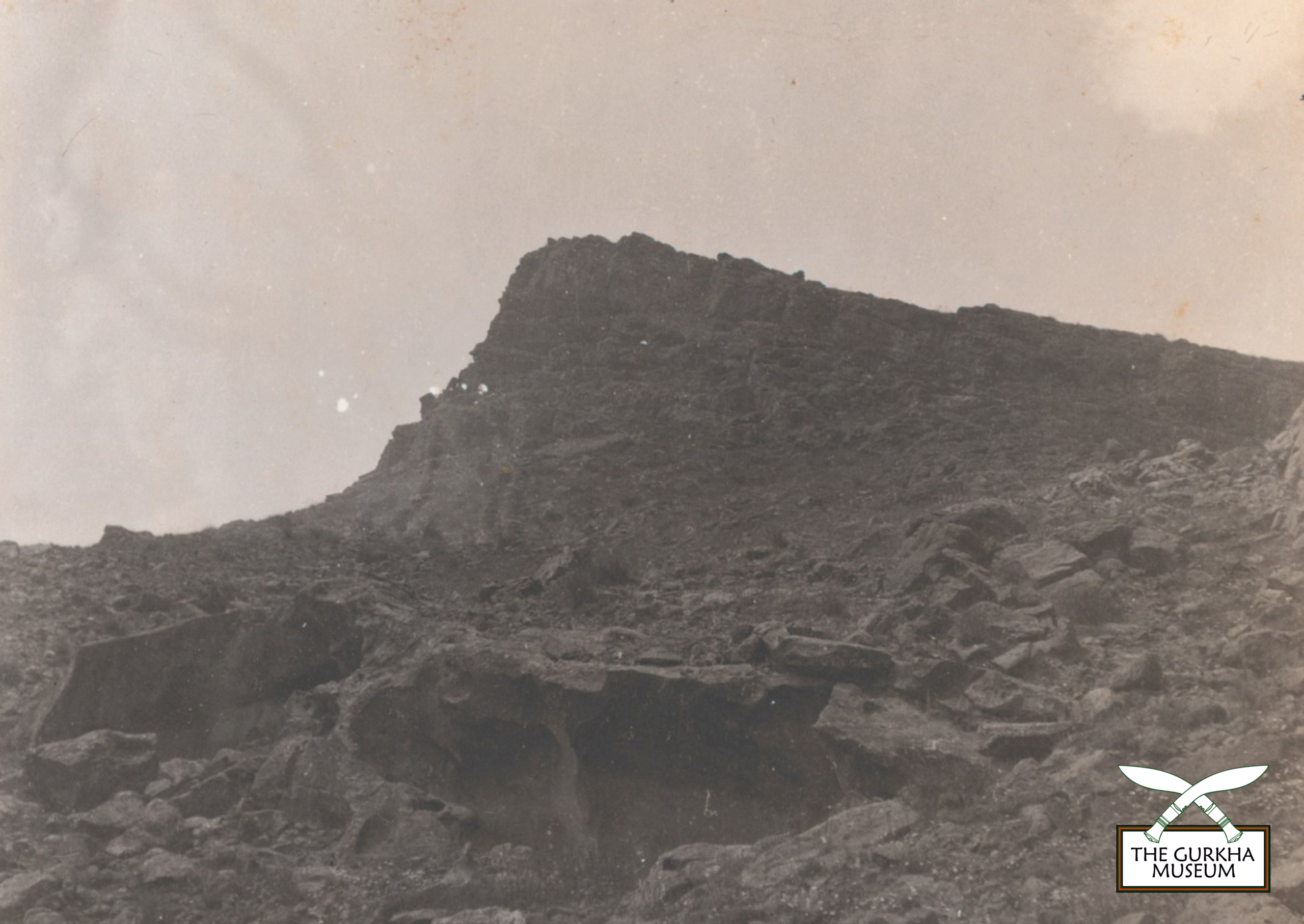
The hill attacked by ‘D’ Company photographed after the battle.
The fighting was no less intense elsewhere. ‘A’, ‘B’ and ‘C’ companies swept through their assigned objectives, with the fighting often devolving into close-quarter, hand-to-hand brawls. Ultimately, the Gurkhas skill with their khukuris carried the day, and by 7 April the battalion had captured its objectives:
‘When light broke on the morning of 7th April the Gurkhas openly walked along the crests or toiled up to their summit positions with heavy loads on their headstraps. Across the valley the Punjabis were singing. Clouds of dust far across the flowering plains showed the enemy to be in full retreat. […] Under the northern slopes of Fatnassa an enemy field dressing station had stood. It was gone now but its dead lay neatly swathed in blankets, waiting for the victors to bury them’.
1/2GRs casualties in the battle had been 14 men killed, with a further 40 wounded.
1/9GR had played a supporting role at Wadi Akarit, following up the first waves to aid in ‘mopping up’. By this time, the enemy’s resolve was crumbling: ‘a flutter of white rags appeared from behind a ridge and 120 Italians ran forward with their hands in the air. They were thumbed off to the rear and doubled off happily without escort’.
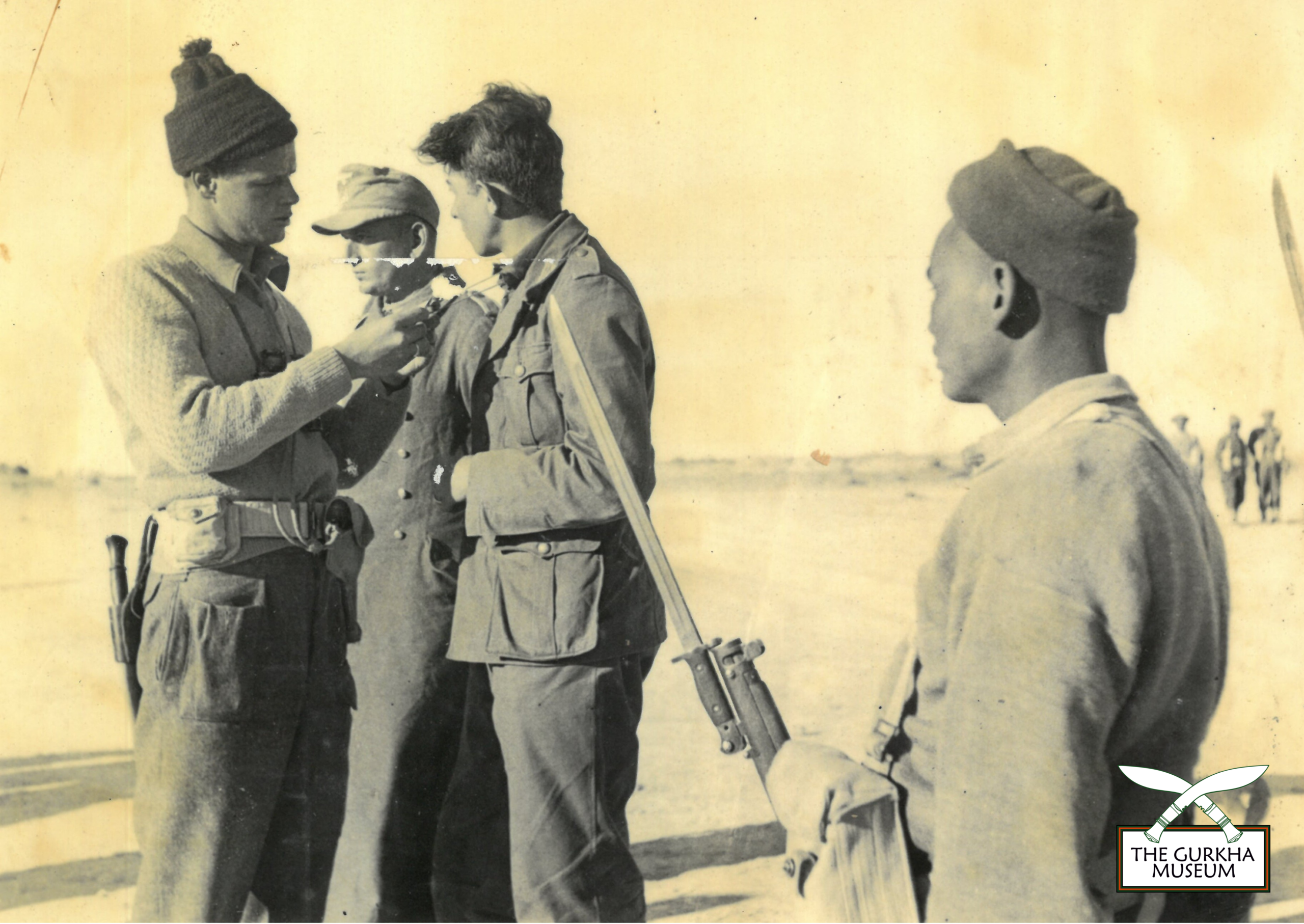
A British Gurkha officer searches prisoners for documentation after a successful nighttime patrol, Tunisia, 1943.
For his actions during the fighting, Subedar Lalbahadur Thapa was awarded the Victoria Cross (VC), the British military’s highest award for gallantry. It was the first VC awarded to a Gurkha soldier during the Second World War and would be far from the last.
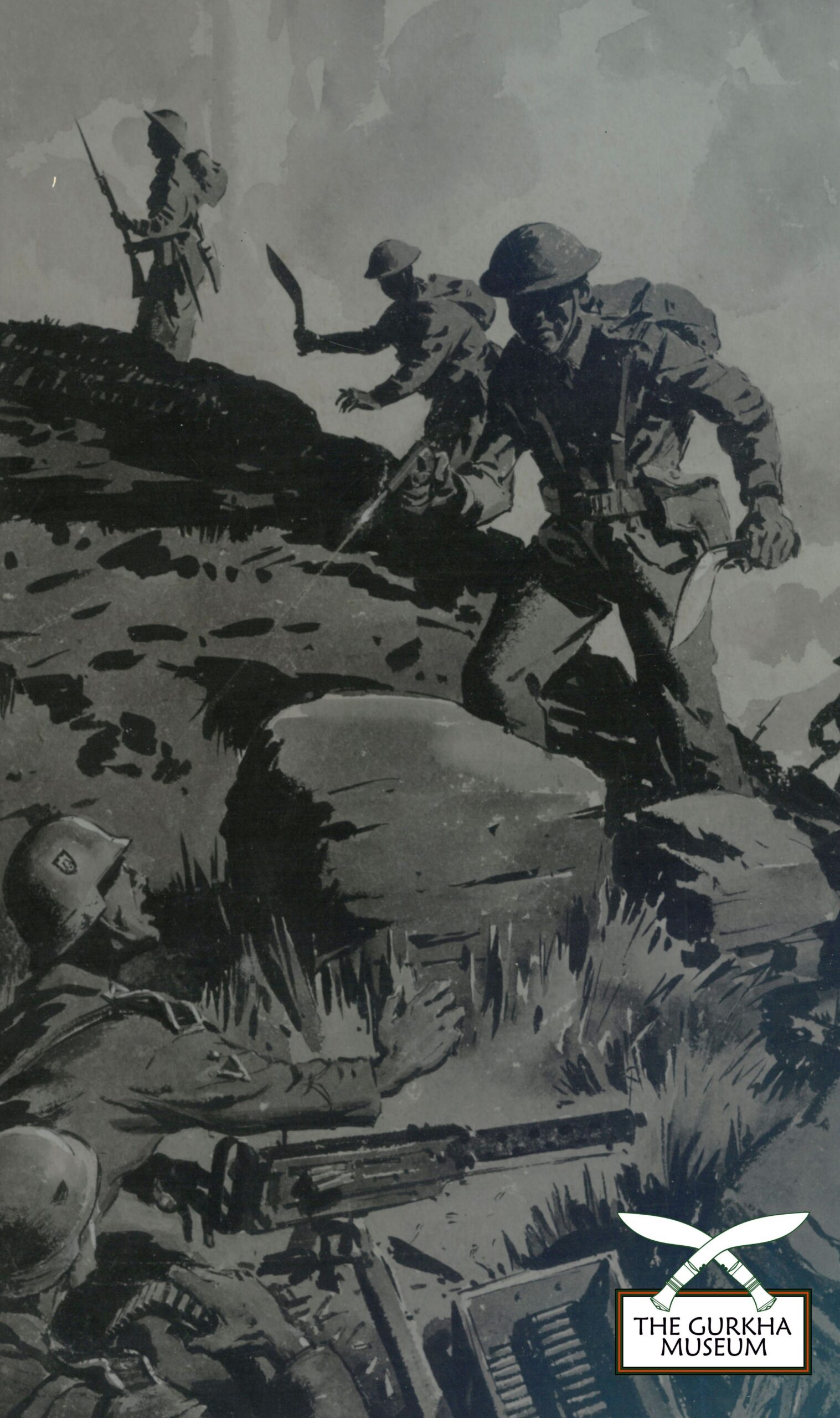
Subedar Lalbahadur Thapa VC storming a German machine gun position, as depicted by artist Harry Sheldon
Djebel Garci and the Run for Tunis
The Battle of Wadi Akarit had been another blow for the Axis, but its forces were not yet ready to surrender. With nowhere to go but forward, the Allies planned renewed attacks toward Tunis, where they would have to push through a last formidable ring of enemy defences.
For its part in the final push, the 4th Indian Division was ordered to take Djebel Garci, a steep, heavily- defended stretch of high ground to the south of Tunis. 5 Indian Brigade would lead the way, with 1/9GR in the second wave.
The attack commenced on the night of 19/20 April. The 4th/6th Rajputana Rifles advanced first, with 1/9GR slated to follow them up once they had taken their objective. But despite their fierce attempts, the Rajputanas were unable to break the German line.
By early morning, 1/9GR was at the base of the slope awaiting the signal to move forward. With the fate of the Rajputanas attack hanging in the balance, Colonel Roche, 1/9GRs commander, decided he could watch and wait no longer. At 3am, the Gurkhas advanced.
Instead of directly reinforcing the Rajputanas and getting caught in the same difficulties, Colonel Roche ordered his men to swing wide of the main attack, aiming for a position called Point 330. If the Gurkhas could seize it, they would threaten the right enemy flank and ease pressure on the Rajputanas.
Advancing through a curtain of mortar fire, it was ‘D’ Company that encountered the enemy first, emerging from the bombardment to see over a hundred Germans charging at them:
‘With Subedar Bhimbahadur in the lead “D” Company counter-charged. Scrambling over rocky ledges German and Gurkha met breast on amid the rip of Spandaus, the crash of grenades and the screams of the stricken. […] The khukuris were out and mortal grapples left clumps of sprawling dead’.
After several minutes the Germans broke off, leaving 44 of their dead behind.
Shortly after, ‘A’ Company arrived and carried the attack forward, with its sections dislodging the enemy and destroying two machine gun positions. This action allowed the remaining unengaged platoon of ‘D’ Company to bypass the German flank and seize the top of Point 330.
By sunrise, all attacking battalions of 5 Indian Brigade had established footholds on Djebel Garci, though the Germans still held the hilltops. A continued assault on the firmly entrenched enemy was deemed too dangerous, so the Allies subjected the hillside to a full artillery bombardment. At the height of this barrage, Allied guns fired eight tons of shells each minute at the German holdouts.
Under the artillery’s steel cover, the men of 1/9GR dug in at their newly captured positions, awaiting further orders and facing intermittent fire from the German positions. However, the weight of the bombardment frustrated the enemies counterattacks, and only half-hearted attempts were made to push the Gurkhas back.
Despite the efforts of the artillery, by 22 April the enemy still remained on the hilltops. The battle was called off that day, with heavy casualties inflicted on the enemy but no decisive breakthrough achieved.
1/9GRs attack was praised by the 4th Division’s commander, General Francis Tuker, who sent a note to the battalion stating:
‘The more I hear of your fine battalion and its fight on the Garci hills the more certain I am that it has written one of the most glorious pages of its history. The Division is proud of you.
Victory
On 7 May 1943, Allied forces liberated Tunis, signalling the collapse of Axis resistance in Tunisia.
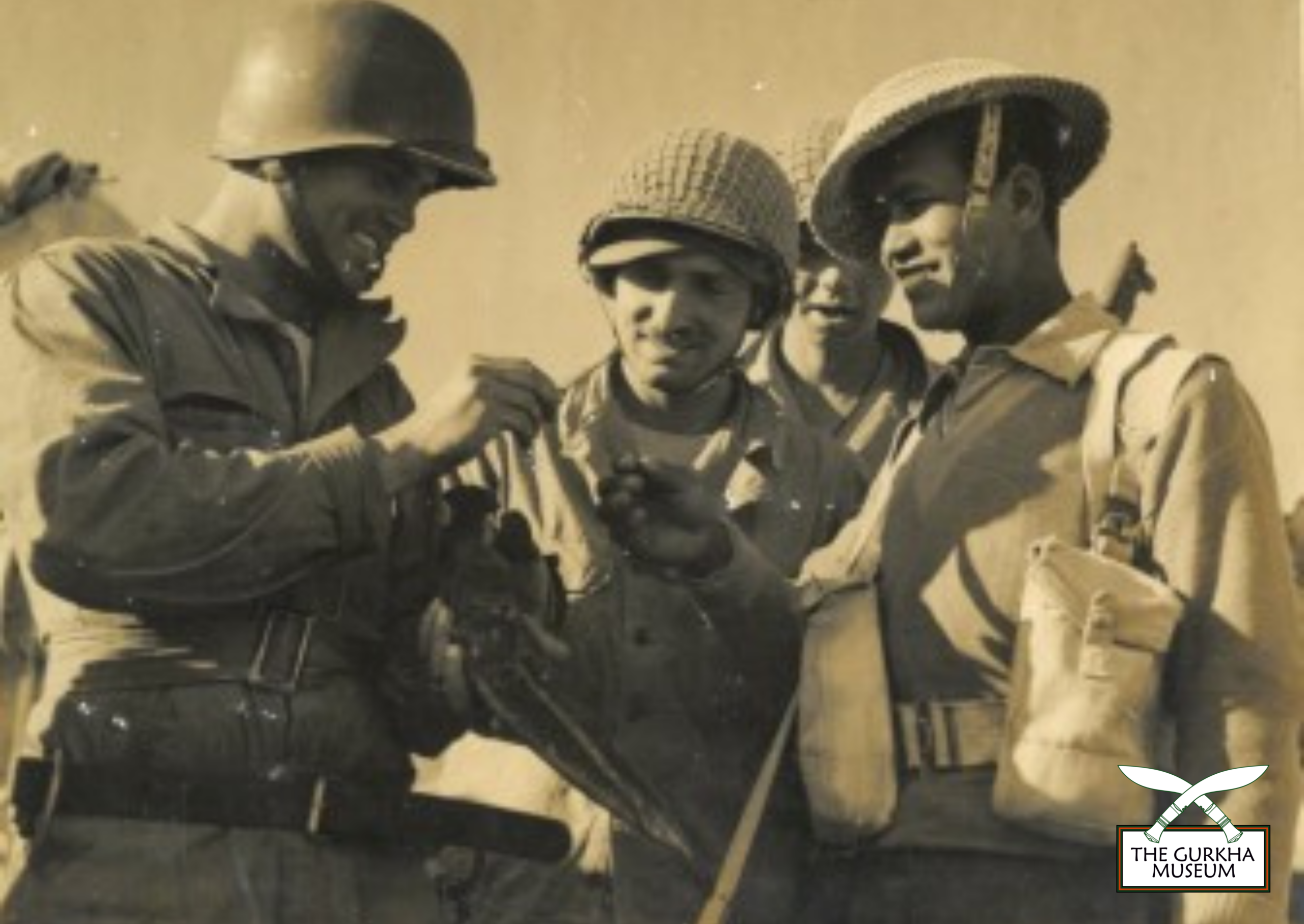
After linking up with U.S. forces, a Gurkha of the 4th Indian Division shows his khukuri to a group of American soldiers. Tunisia, May 1943.
Amidst this crumbling German resistance, the Gurkhas would manage one final feat in the campaign – the capture of the Axis commander, General von Arnim.
On 13 May, 1/2GR was in pursuit of retreating German forces across 30 miles of rough terrain. The battalion commander, Colonel Showers, was driving ahead of the battalion with his orderly, Rifleman Sarganah Limbu. Coming over a hill, they found a German staff officer. Commandeering his car, the pair drove past columns of surrendering German soldiers.
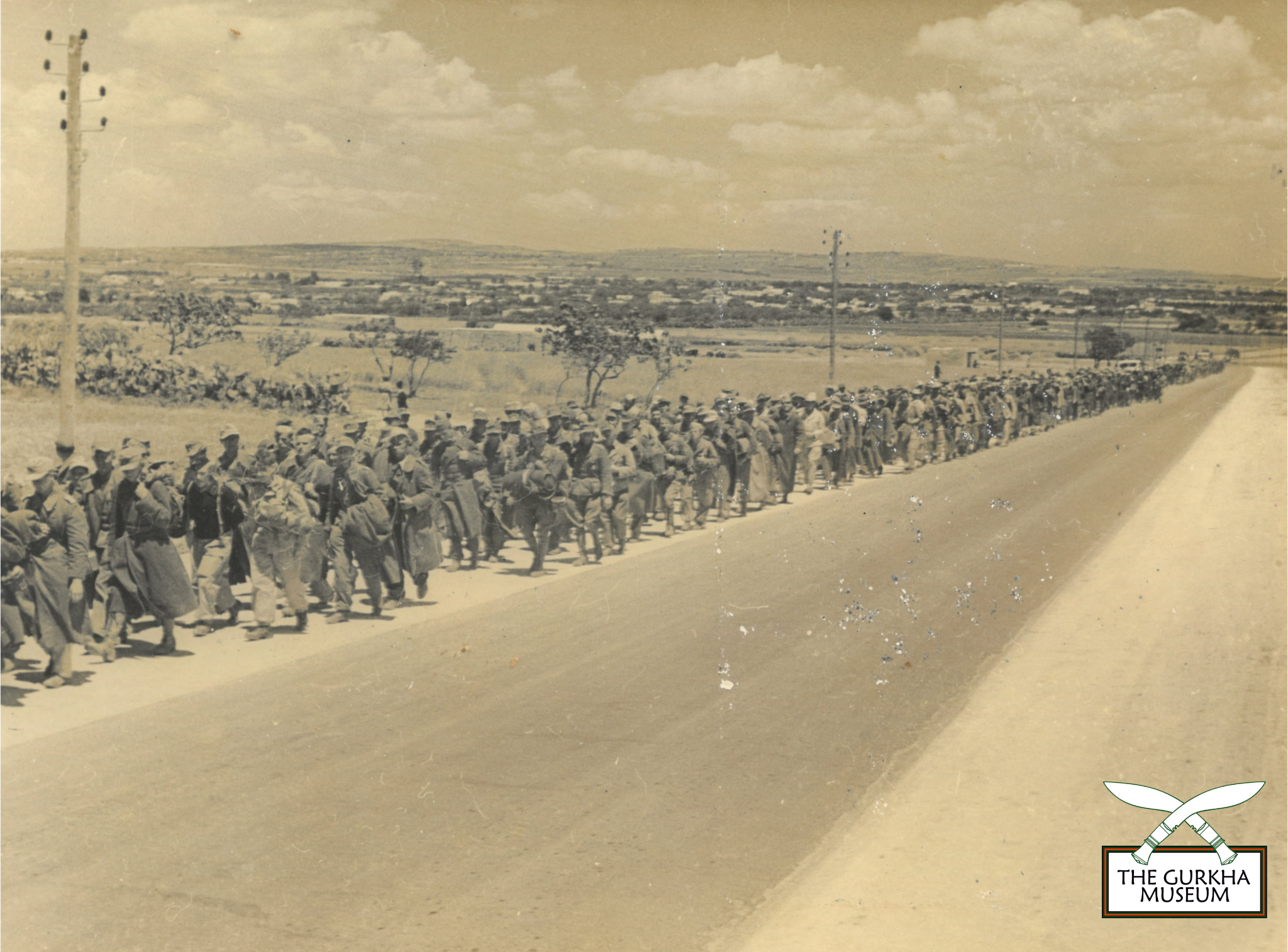
German and Italian soldiers march into captivity after the liberation of Tunis, May 1943.
After a short drive, they found General von Arnim’s headquarters. Showers later described the scene:
‘We got out of the car and walked to Von Arnim’s caravan. I must have looked a grim sight, covered in dust and sweat, two days beard, a plaster on a cut over one eye, a captured Luger pistol and a khukuri on my belt, my orderly with his Tommy gun at the ready, taking no chances. Real pirates we must have seemed to the neat German staff officers, but they were all most polite and punctilious about saluting’.
After a conference with British General’s Francis Tuker and Charles Allfrey, von Arnim formally surrendered to the Allies, bringing the Tunisian Campaign to a close. Victory had come at the cost of almost 80,000 Allied casualties. Between them, 1/2 and 1/9GR had suffered 92 fatalities.
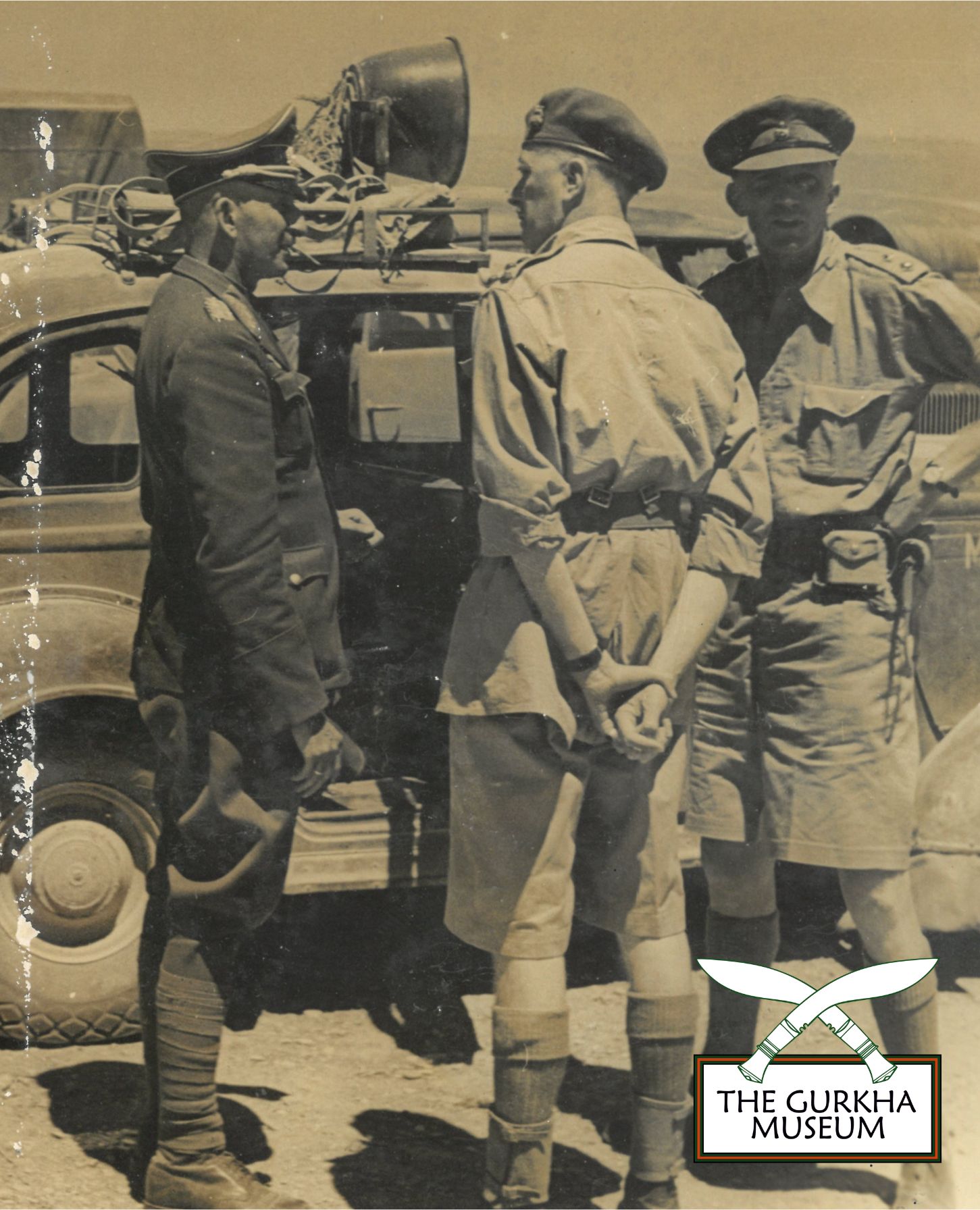
General von Arnim (left) at the headquarters of the British 1st Division, May 1943
The defeat of their forces in North Africa proved a staggering blow for the European Axis powers. It led not only to their expulsion from North Africa and ended any dreams of seizing the Suez Canal, Egypt or the oilfields of the Middle East, but also caused the capture of approximately 300,000 soldiers, whose experience Germany and Italy could not easily replace.
Several British commanders (including General, later Field Marshal, Bernard Montgomery) had previously expressed doubts about the effectiveness of Indian Army troops. The Tunisian Campaign proved them wrong. When Allied forces moved into Italy in September 1943, Gurkha soldiers would be increasingly relied upon to lead the charge.
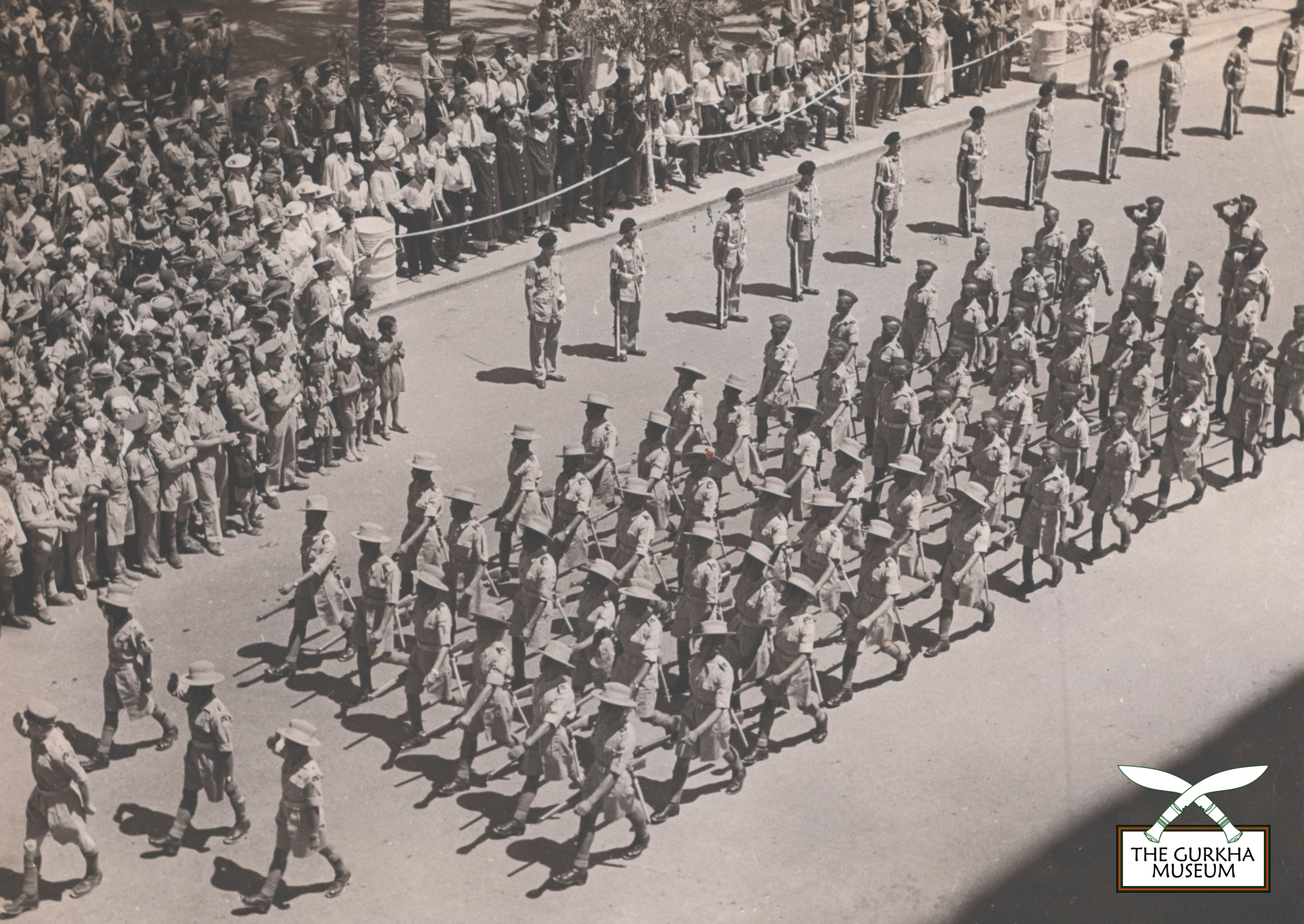
Gurkha soldiers marching as part of a victory parade in Tripoli, Libya, 1943.