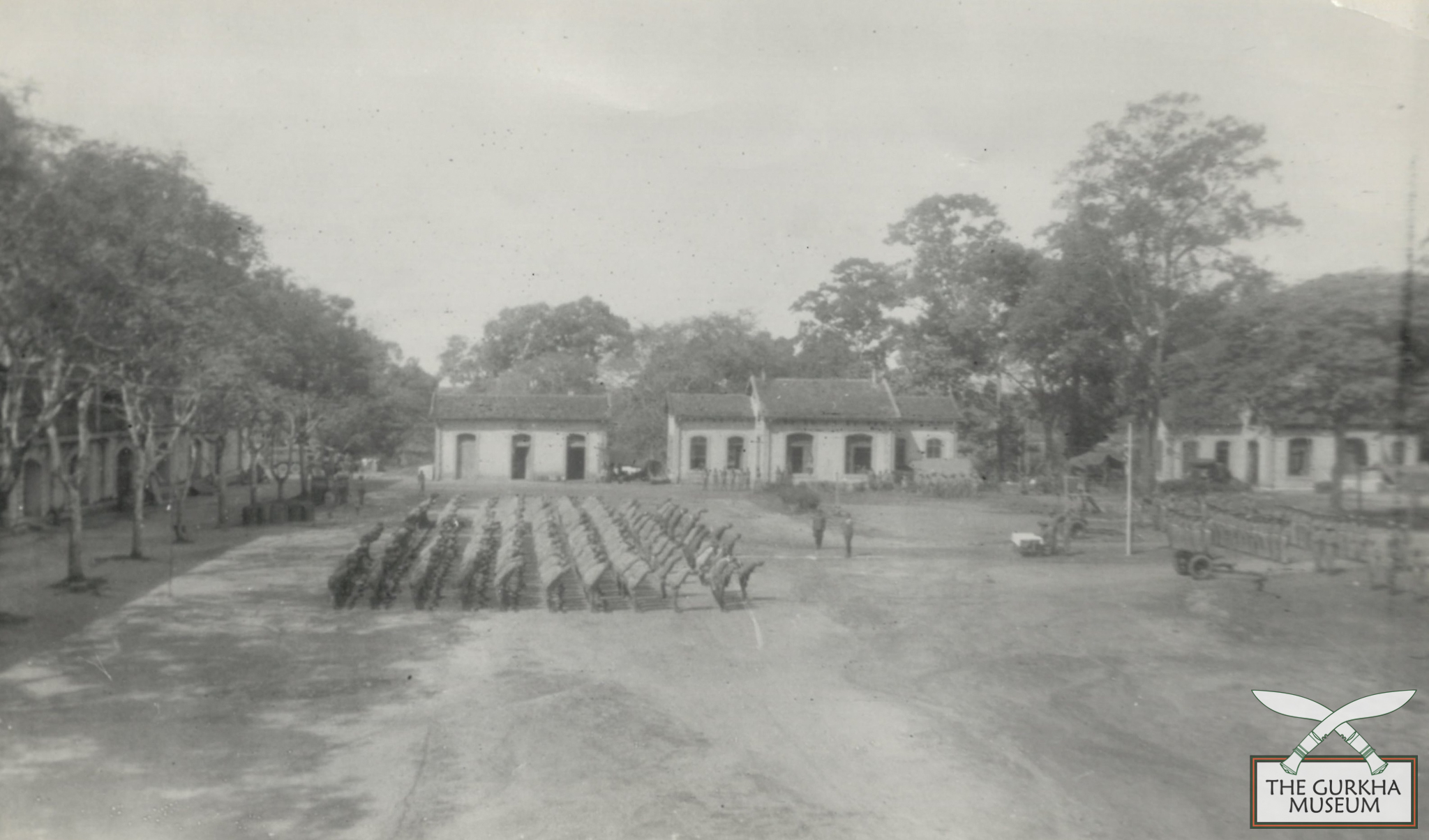
The aftermath of the Second World War saw chaos flare across southeast Asia. In September 1945, the sudden end of Japanese occupation caused conflicts to erupt in French Indochina (now Vietnam, Laos and Cambodia) and the Dutch East Indies (now Indonesia). In many cases, these conflicts were rooted in opposition from the local population to the return of European colonial authority. Several Gurkha battalions would soon be pulled into the fighting, in some cases seeing combat as intense as any they had faced during the war.
Beginning in late-September 1945, Operation Masterdom called for the 20th Indian Division to deploy into southern Indochina (historically referred to as Cochin-China) to disarm and repatriate 70,000 Japanese soldiers.
Indochina had been part of the French colonial empire from the late-19th century until 1940, when it was occupied by the Empire of Japan. The Japanese remained in the region for 5 years, during which time they attempted to stoke anti-European sentiments among the local population.
Because the fighting had never reached most of Indochina, the Japanese garrison remained intact. Disarming this force of well-equipped and undefeated troops was an immediate anxiety for the Allies. The 20th Indian Division, which contained three Gurkha battalions, began landing in Indochina in October. However, it became quickly apparent to the Division’s commander, Major General Douglas Gracey, that their mission would be far more complicated than imagined.
Resistance
The French colonial regime’s legacy in Indochina includes economic exploitation, forced labour and violence against Vietnamese, Laotian and Cambodian peoples. Since the 1880s, simmering resentments among the Vietnamese had broken out into sporadic uprisings, all of which had been supressed by French colonial forces.
The Imperial Japanese Army entered French Indochina in September 1940. They aimed to blockade the country and prevent arms and supplies from passing through it into China, with whom they were at war. The political background for the occupation was complex – at the time, Indochina was administered by Vichy France, a Nazi puppet state. Because of this, Japanese and French troops in the region were technically allies. However, there was nothing the Vichy government could do beyond tolerate the presence of Japanese soldiers in the territory. Following the effective collapse of Vichy France in early 1945, the Japanese set up their own puppet regime that would continue until the end of the war.
During its occupation, the Japanese attempted to present themselves to the Vietnamese as benevolent occupiers. Although some Vietnamese were receptive to these ideas, the reality was that the Japanese were no less exploitative than the French. In 1944, the combined causes of resource extraction, economic mismanagement and strategic Allied bombing triggered a devastating famine across the country. Though casualty reports vary, the famine may have caused the death of between 1- 2 million people between 1944 – 1945.
These factors contributed to the growth of the League for Independence of Vietnam, more commonly referred to as the Việt Minh. Founded by politician and revolutionary Ho Chi Minh in 1941, by 1945 the Việt Minh had grown into a significant political and paramilitary force. Wary that the Allies may try to return Vietnam to French control, the Việt Minh prepared their forces to resist.
Far from simply repatriating Japanese soldiers, the Gurkhas of the 20th Division would find themselves drawn into an emerging civil conflict.
Old Enemies, New Allies
When the 20th Indian Division began landing in Indochina in early October 1945, the situation was already unravelling. French colonial administrators, now released from Japanese internment, rapidly began reasserting control. This quick return had caused significant backlash from the Vietnamese, resulting in mass strikes and increased activity from armed groups of Việt Minh fighters throughout the country.
Initially, General Gracey attempted to approach the situation diplomatically. However, the killing of French civilians, and the inability of the French to restore order, forced the 20th Division to take on internal security duties.
On 12 October, the 4th Battalion, 2nd Gurkha Rifles (4/2GR) began operations in Saigon (now Ho Chi Minh City). Accompanied by a complement of armoured cars, on 14 October it seized a bridge over the Saigon river against heavy enemy fire. 10 Việt Minh fighters were killed in the skirmish for the cost of two Gurkhas wounded. After seizing several more bridges, a foothold was gained on the outskirts of the city.
Around this same period, a strange arrangement emerged. Given that French forces were too few in number to effectively contribute to security efforts, the only additional pool of soldiers that the British could draw upon were the Japanese troops they had come to disarm. For the next several months, Gurkha soldiers across Indochina would operate alongside the Japanese, whom they had been fighting a bitter war against several months before.
This arrangement was not an immediately comfortable one. Lieutenant Colonel John Cross, who as a young officer served in Indochina with the 1st Battalion, 1st Gurkha Rifles (1/1GR), described one Gurkha Naik (corporal) becoming quite alarmed when a Japanese officer drew his sword to salute him. Though cooler heads prevailed, the Naik remained alert until the Japanese officer returned the sword to its sheath.
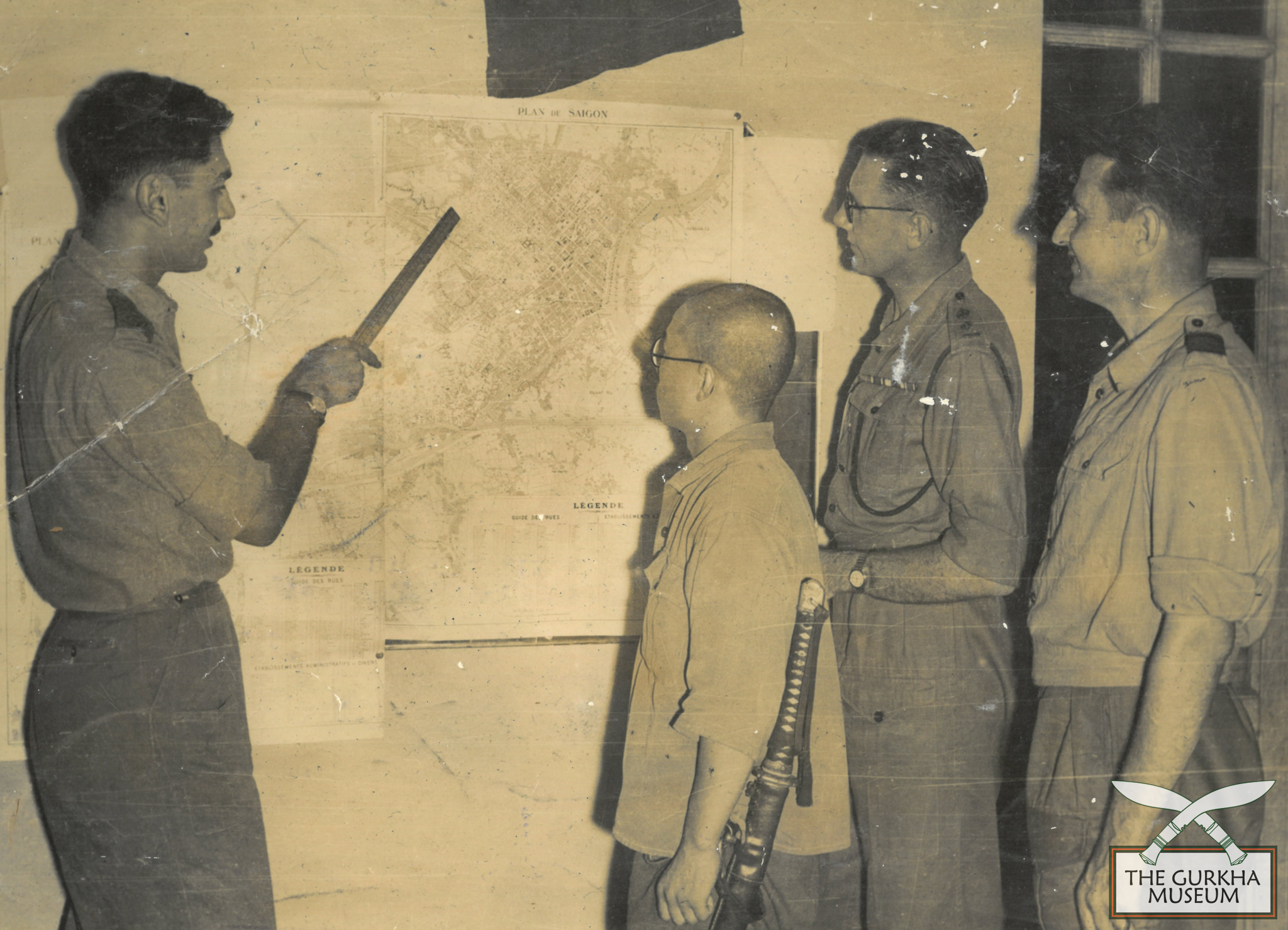
Lieutenant Colonel E.D. Murray (2nd from the right) of the 4th Battalion, 10th Gurkha Rifles being briefed on the security situation in Saigon. With him is Lieutenant Yoshiaki Shoji (centre), a Japanese liaison officer.
Thus supported, 4/2GRs security sweeps in Saigon continued. These were described by the battalion commander, Colonel Kitson:
‘Our day-to-day activities were strenuous but they did not make history. Day and night there was usually trouble somewhere. Up to the end our bridge posts were sniped regularly. Patrols were continuously searching the countryside for rebels and houses for arms’.
Việt Minh forces in Saigon intensified attacks in November. On 2 November, a platoon from 4/2GRs ‘B’ Company was ambushed. Fortunately, quick action by Naik Bhagtabahadur Pun prevented casualties, and 3 enemy fighters were killed. Further action occurred on 6 November, when ‘D’ Company engaged in street fighting in the Ben Cat district, alongside two companies of Japanese soldiers. The fighting resulted in 22 Việt Minh killed and 257 captured.
The 1st and 3rd battalions of the 1st Gurkha Rifles were also involved in the Saigon fighting. Rifleman Tekbahadur Ghale (1/1GR) won the Military Medal when he braved enemy fire to carry the wounded Jemadar (Gurkha Lieutenant) Churamani Thapa to safety.
1/1GR moved further north in October, concentrating around Thu Dan Mot. This rural area was good country for ambushes, and the Việt Minh frequently harassed Allied convoys. In the following weeks, Gurkha and Japanese troops took great effort to secure the roads. 1GR’s regimental history states that some 4,500 Japanese troops were employed in guarding the area. As in Saigon, skirmishes occurred. However, by December 1/1GR was able to begin its work of disarming the Japanese. Its total casualties in Indochina amounted to 5 killed and 14 wounded.
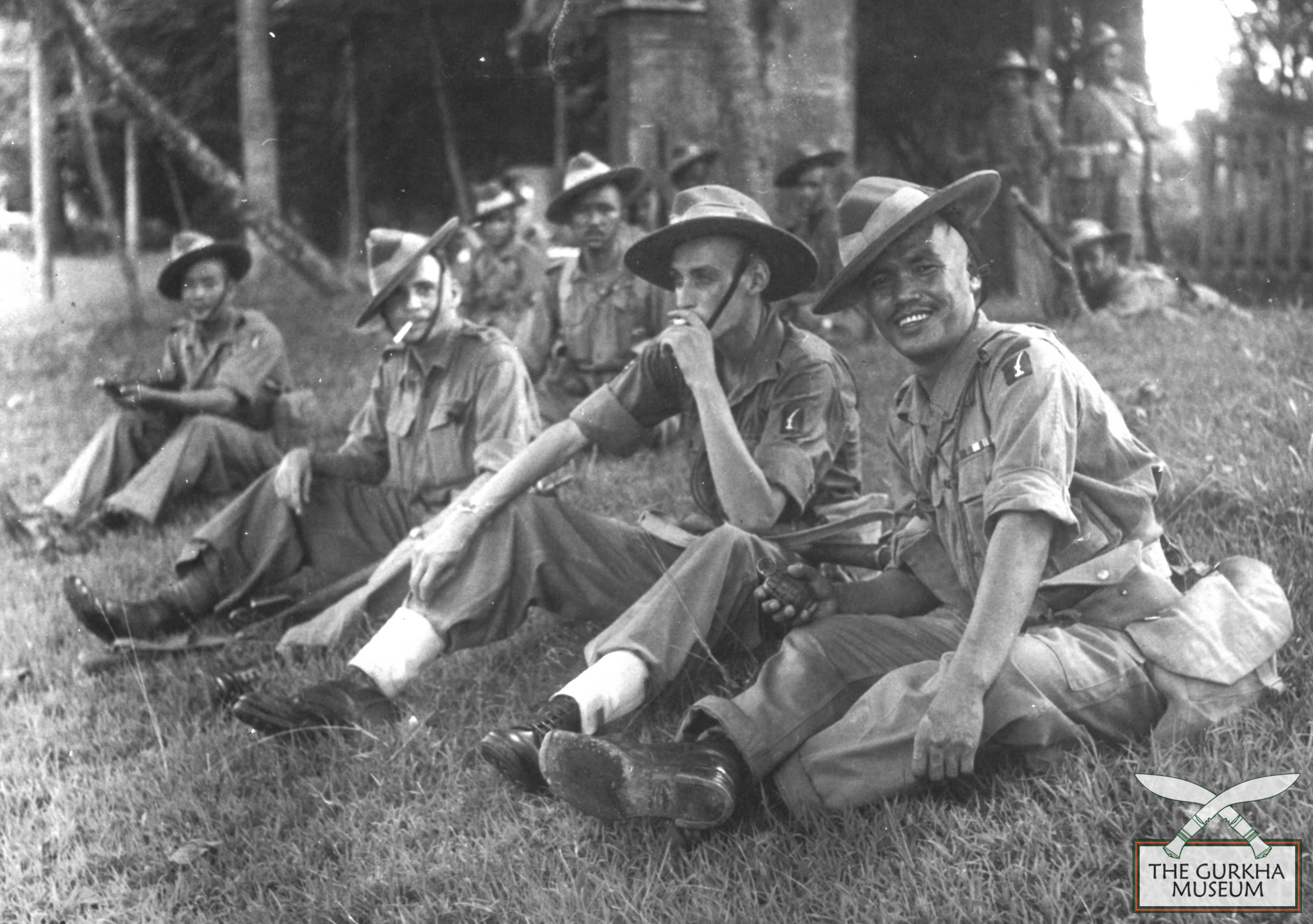
Officers and men of 1/1GR take a moment to rest by the Saigon river, 1945.
In mid-December, 4/2GR took part in an expedition onto ‘Hanh Pu Island’, a peninsula at the confluence of the Cho and Saigon rivers. Landing on the beaches, the battalion almost suffered a friendly fire incident by a poorly planned artillery barrage. ‘B’ and ‘C’ companies advanced across the island, finding a number of abandoned Việt Minh positions and supply stores.
Contact was eventually established, and the two companies had an hour long firefight with around a hundred Việt Minh fighters. The Việt Minh were ultimately forced to withdraw, leaving behind 30 dead. The dispersed Việt Minh positions caused confusion throughout the battle, with the Gurkhas suffering casualties when a French armoured jeep accidentally opened fire on them.
Nevertheless, the island was eventually secured. In late-December, security in Saigon was handed back over to the French. 4/2GRs operations in and around the city had not been too taxing for the battle hardened Gurkhas, but had nevertheless cost 4 men killed and 10 wounded.
Aftermath
With internal security returned to the French, the Gurkhas were able to get on with what they had been sent to Indochina to do – disarm Japanese troops. Between December 1945 to January 1946, Japanese battalions began handing their weapons over to Allied forces.
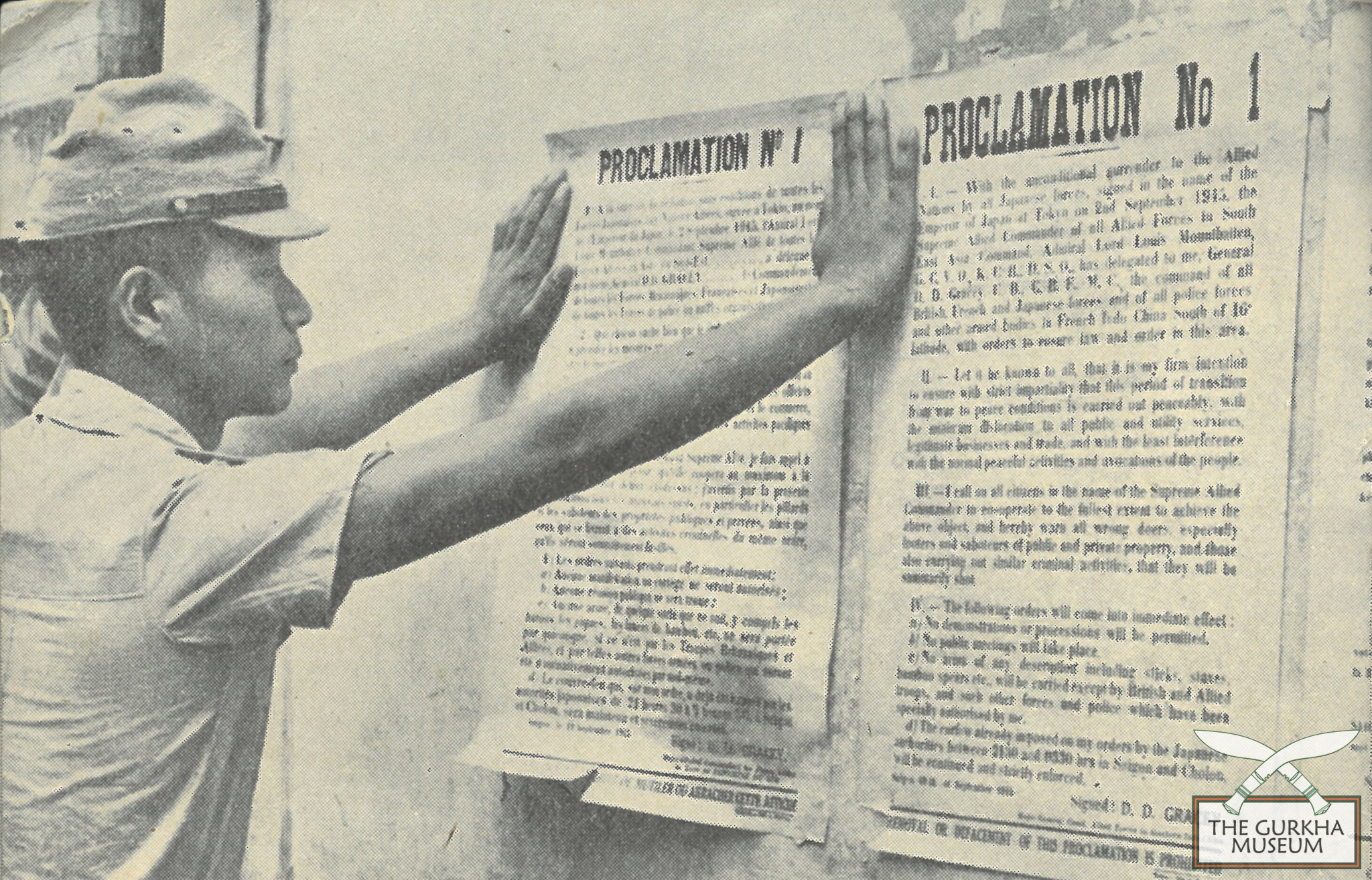
A Japanese soldier posts up a proclamation from the Commander of the Saigon Control Commission. The proclamation limits the movements of Japanese soldiers.
Among the notable Japanese officers that surrendered to the Gurkhas was Lieutenant General Aketo Nakamura, commander of the 18th Area Army. He surrendered to Major Denis Rawlins of the 4th Battalion, 10th Gurkha Rifles (4/10GR), based at Thủ Đức. A company of 4/10GR was also detached to Cambodia, where it assisted in disarming two Japanese divisions. The 10GR regimental history reports that it was involved in the surrender of 50,000 Japanese troops whilst stationed in Indochina.
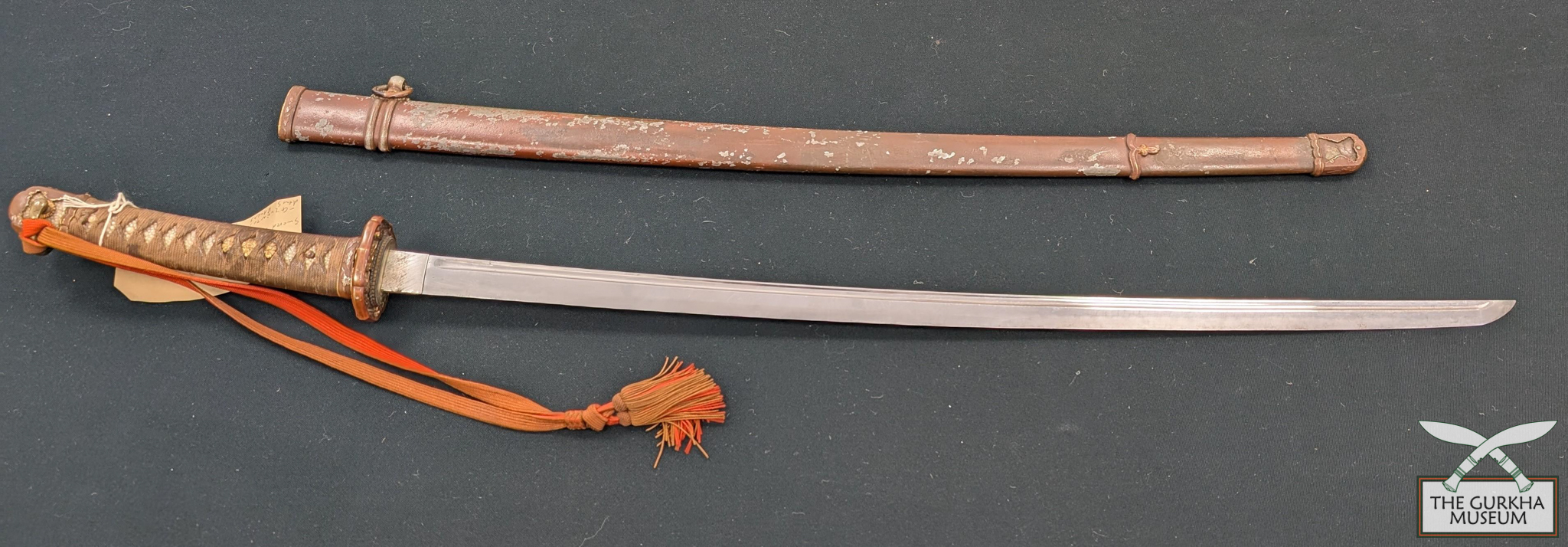
The sword of Lt General Aketo Nakamura, which was donated to the Gurkha Museum by the family of Major Rawlins in 2023.
In January 1946, 1/1GR took the surrender of the Yamagishi Butai, a Japanese battalion that had served closely alongside the Gurkhas during the fighting around Thu Dan Mot. Its commander, Captain Yamagishi, saluted Subedar Major Balesor Rana and laid down his sword. Following him, the Japanese NCOs saluted and laid down their weapons one-by-one.
Soldiers of the Yamagishi Butai formally surrender to 1/1GR.
With its objectives met, the 20th Indian Division began to leave Indochina. 4/10GR was the last Gurkha unit to leave, departing from Saigon on 12 February 1946.
The withdrawal of British forces left the country under French control. Unfortunately, the former status quo soon returned, with the French regime in Indochina continuing to cause suffering for the local population.
During the security operations in 1945, the brutal approach of French troops had been criticised by British officers. Colonel Mullaly, who commanded 4/10GR, was shocked when a single grenade thrown at a French convoy had prompted the soldiers to throw grenades into all of the surrounding houses and open fire on nearby civilians.
The mistreatment of the Vietnamese would be the undoing of the French regime. By December 1946, fighting between the French and the Việt Minh had resumed. In the early-1950s, the Việt Minh became increasingly communist, and started receiving support from the Soviet Union and China. Now fighting on more even terms, the Việt Minh defeated the French in 1954, ending their rule in Vietnam. In the following decades the conflict in Vietnam would draw in the United States and many of its allies, who opposed the spread of communism in southeast Asia. Ultimately, the US were unsuccessful in their aims, and soon after their withdrawal in 1975 the unified Socialist Republic of Vietnam was formed in 1976.
To hear a first-hand account of the Gurkha deployment to Indochina, listen to this oral history by Lt. Col John Cross (JPX), who served with the 1st Battalion, 1st Gurkha Rifles in Indochina in 1945.
The Gurkha Museum Trust is the Brigade of Gurkhas’ heritage charity (registered charity number 1169920). The Gurkha Museum Trust is dedicated to the preservation, protection, and promotion of the heritage and culture of the Brigade of Gurkhas.
To discover more about the Gurkhas’ contributions to ending the Second World War and to keep informed about Gurkha heritage sign up to our free e-newsletter or as a Friend of The Gurkha Museum.
Discover more about 210-years of service and sacrifice, delivered directly to your inbox. Register to receive a monthly e-newsletter with inspiring and interesting stories on Gurkha heritage, insights on unique artefacts and updates from us.