The Rise of Gorkha
Before the 1700s, Nepal was not a unified country. The region instead consisted of a number of culturally connected but politically independent kingdoms.
In 1743, Prithvi Narayan Shah ascended to the throne of the small Kingdom of Gorkha, which lay about sixty miles west of Kathmandu. Prithvi had great ambitions for his kingdom, and over the next two decades would expand its borders through conquest.
With his ranks composed mostly of formidable ‘Gorkha’ (later anglicised to ‘Gurkha’) warriors, Prithvi defeated several nearby kingdoms and added their territory to his own. Eventually, he set his sights on the Kathmandu valley itself, capturing it in 1768 after a difficult campaign. With this victory, he gained control of the entirety of the Kathmandu valley and laid the foundations of the Kingdom of Nepal.
Although he died in 1774, his dream for a strong, unified kingdom endured in his successors. From the 1780s, the fledgeling kingdom of Nepal begun to extend its conquests outside of its traditional homeland, with invasions into Tibet to the north, Sikkim to the east, and Garhwal and Kumaon to the west.
These conquests into surrounding regions brought it into the notice of international powers. In 1788, Nepal’s attacks into Tibet caused a confrontation with China, resulting in the Sino-Nepalese War. In 1792, Chinese troops advanced deep into Nepal, coming to within twenty miles of Kathmandu. With their capital threatened, the Nepalese government sued for peace and a treaty was signed in October 1792.
With Nepal’s northward expansion checked, its leaders looked elsewhere for its conquests. In the early 1800s, increasing raids to the south would bring Nepal into conflict with another international power, the British Honourable East India Company.
The Anglo-Nepal War
By the beginning of the 19th century, the Honourable East India Company (HEIC), headquartered in London, was the largest company in the world and oversaw around half of all international trade.
The HEIC backed its economic might with a large army. A greater part of the HEICs forces consisted of Indian troops recruited from lands it administered. It was also common for regular troops of the British Army to come under the HEIC’s command, given that the Company nominally acted in the interests of the British Empire.
Since the mid-1700s, relations between the HEIC and Nepal had been uneasy. Conflict between the two had briefly flared up in 1767 when a column of HEIC soldiers attempted to support Kathmandu against Prithvi Narayan Shah’s conquests. Under the command of Captain George Kinloch, the column was plagued by poor weather, unforgiving terrain, and ambushes by Gurkha warriors. After suffering numerous desertions and casualties, the small force retreated to India.
For the next 50 years relations remained frosty but no further fighting broke out. However, by 1814 Gurkha raids had reached far enough south that they were encroaching into territory to which the HEIC laid claim.
HEIC ambitions would likely have turned toward Nepal regardless. Stakeholders within the company wanted to increase trade with China, which would mean establishing a trade route from northern India into Tibet. Doing this, however, would mean going through Nepal.
Seeing the raids as an excellent pretext, the HEIC mustered a large retaliatory force, consisting of both British and Indian soldiers. Dividing their army into four columns, the HEIC invaded Nepal in autumn 1814. With thousands of soldiers, extensive provisions, and modern artillery, HEIC forces had expected the war to be brief, critically underestimating the fierceness and determination with which the Gurkhas would defend their lands.
The first test for the HEIC came at the Battle of Kalunga. 1,600 British and Indian soldiers, commanded by Major-General Rollo Gillespie, arrived at the small hill fortress of Kalunga in October 1814. Defended by only six hundred Gurkha warriors, the attackers outnumbered them almost 3 to 1. But despite their disadvantage, the Gurkhas furiously resisted multiple attacks by HEIC forces and, on 31 October, sortied out of the fort and charged with their khukuri Seeing this, General Gillespie charged forward, but was soon killed by a rifle bullet to the heart.
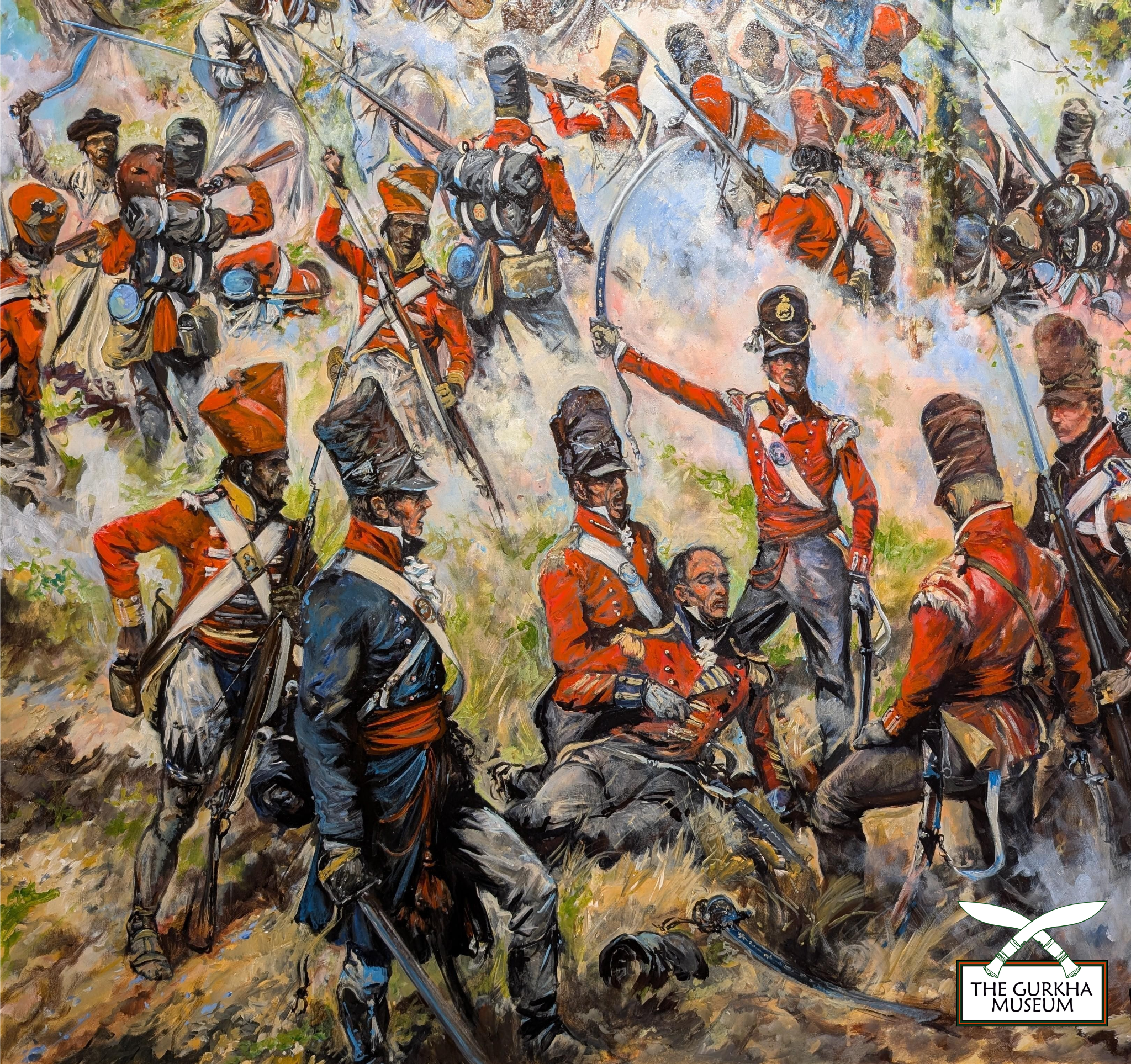
Detail from the ‘Battle of Kalunga’ by Jason Askew, depicting the death of Major General Rollo Gillespie.
After further attacks and an extensive bombardment, the Gurkhas once again charged out of the fort on 29 November, breaking through the HEICs lines and escaping. There were only seventy survivors from the original garrison of six hundred.
Although the HEIC were eventually able to occupy the fort, this was only achieved after severe casualties to its forces, with approximately 750 men being killed or wounded. In the wake of General Gillespie’s death, command of the invasion was passed to General David Ochterlony. For the HEIC, the effort to take Kalunga was a sign of the struggle to come.
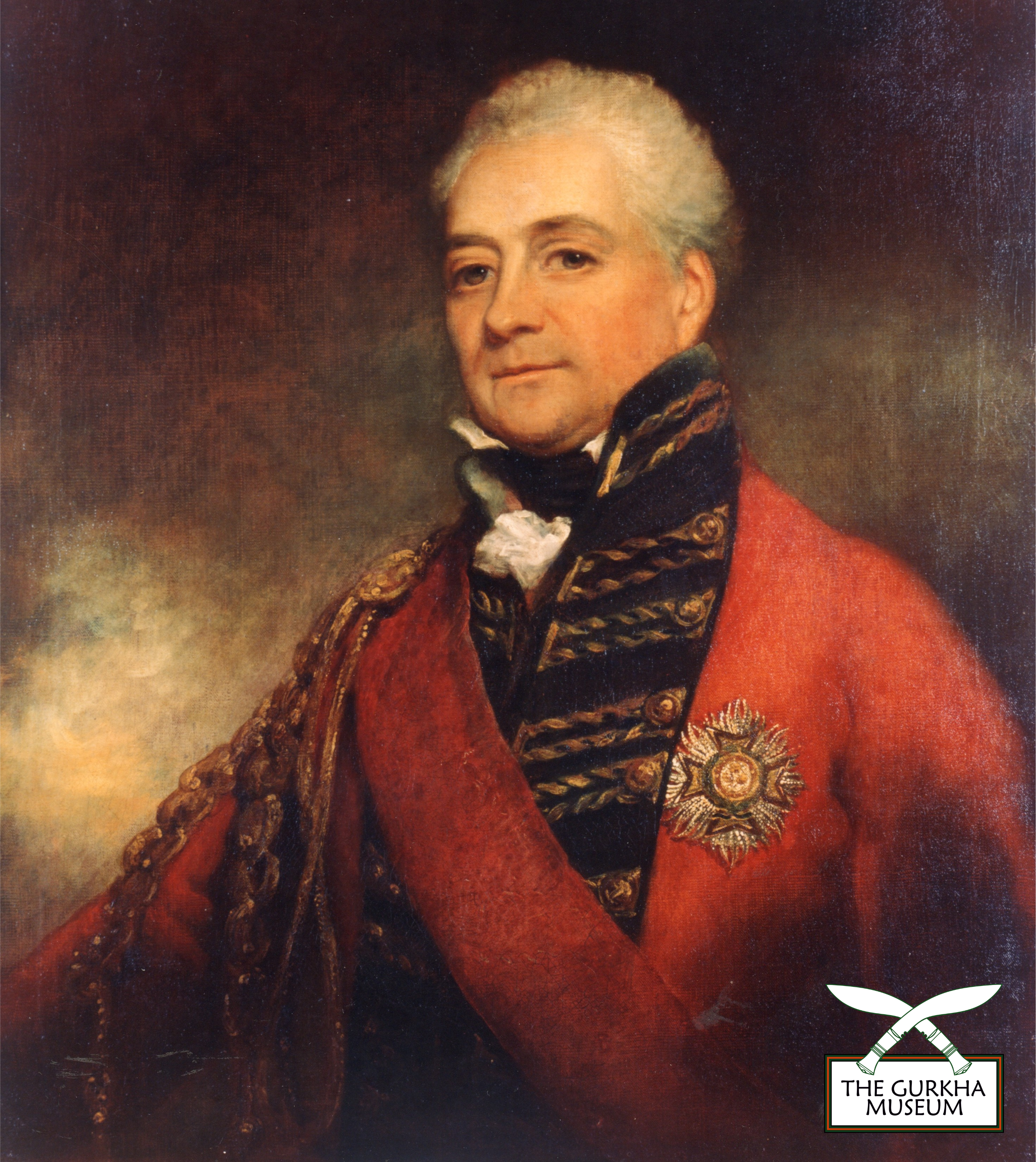
General David Ochterlony.
Some within the HEIC’s forces, such as Lieutenant Frederick Young, were so impressed with the Gurkha warriors that they began to investigate the possibility of recruiting them. Throughout 1815, HEIC officers raised irregular forces from the local hill tribes that were referred to as Gurkha battalions, though the recruits often consisted of men from Garhwal and Kumaon.
Meanwhile the main HEIC forces, having learned a hard lesson at Kalunga, continued the war more cautiously. In May 1815, General Ochterlony won a significant victory at Malaun, capturing the fort and its commander, Amar Singh Thapa.
A powerful general and governor, Amar Singh signed a surrender agreement with General Ochterlony that effectively brought the war to an end on the Malaun front. This treaty laid the first foundation of formal Gurkha recruitment, including the provision that; ‘All troops in the service of Nepaul […] will be at liberty to enter into the service of the British Government, if it is agreeable to themselves and the British Government to choose to accept their services…’
Although the HEIC had won the fighting in the west, the Nepalese government refused to capitulate. Subsequently, a second campaign into Nepal commenced in January 1816, again led by General Ochterlony. Once again splitting his forces, Ochterlony took the main column toward the fortress of Makwanpur.
Advancing toward Makwanpur, HEIC forces were engaged in a brutal fight for the village of Sikhar Khatri, which lay on the approach to the fort. HEIC forces prevailed, but only after suffering over two hundred casualties. Gurkha casualties were even higher, with around seven hundred killed and wounded. Once again, the Gurkhas had impressed their British opponents, with one officer commenting: ‘I never saw more steadiness or more bravery exhibited by any set of men in my life. Run they would not and of death they seemed to have no fear…’
Although demoralised, the Gurkhas still held a prominent ridge and were unwilling to surrender. For Ochterlony, time was running out as his men began to fall victim to malaria. On 3 March, he sent a battalion up the ridge to exert pressure on the Gurkhas positions. In the east, the HEIC had gained another victory at Hariharpur, where they compelled the surrender of 1000 Gurkhas.
Finding themselves in an increasingly uncomfortable strategic situation, the Nepalese government finally sued for peace.
The Treaty of Sugauli
This peace took the form of the Treaty of Sugauli, which had been sent to the Nepalese government in December 1815. However, it was not until the following spring that the Nepalese leaders were willing to ratify it.
The Treaty consisted of nine articles, many of which required Nepal to make steep territorial concessions. Nepal surrendered many of its recent conquests, including Sikkim, shrinking Nepal to roughly its current borders.
The Anglo-Nepal War had been costly for both sides, and no one wanted to see a resumption of hostilities. As such, the Treaty was drafted not only to ensure peace, but also a lasting diplomatic relationship. Article 1 of the Treaty states: ‘There shall be perpetual peace and friendship between the Honourable East India Company, and the Raja of Nipal’. To ensure continued diplomatic relations, it was agreed that an ‘accredited minister from each shall reside at the court of the other.’ Subsequently, HEIC employee Edward Gardner remained in Nepal as the company’s first resident in Kathmandu.
With the end of the war, Gurkha recruitment would continue, and by the end of 1816 there were four Gurkha battalions:
- 1st Nusseree Battalion (later the 1st Gurkha Rifles)
- 2nd Nusseree Battalion (disbanded in 1830)
- The Sirmoor Battalion (later the 2ndGurkha Rifles)
- The Kumaon Battalion (later the 3rd Gurkha Rifles)
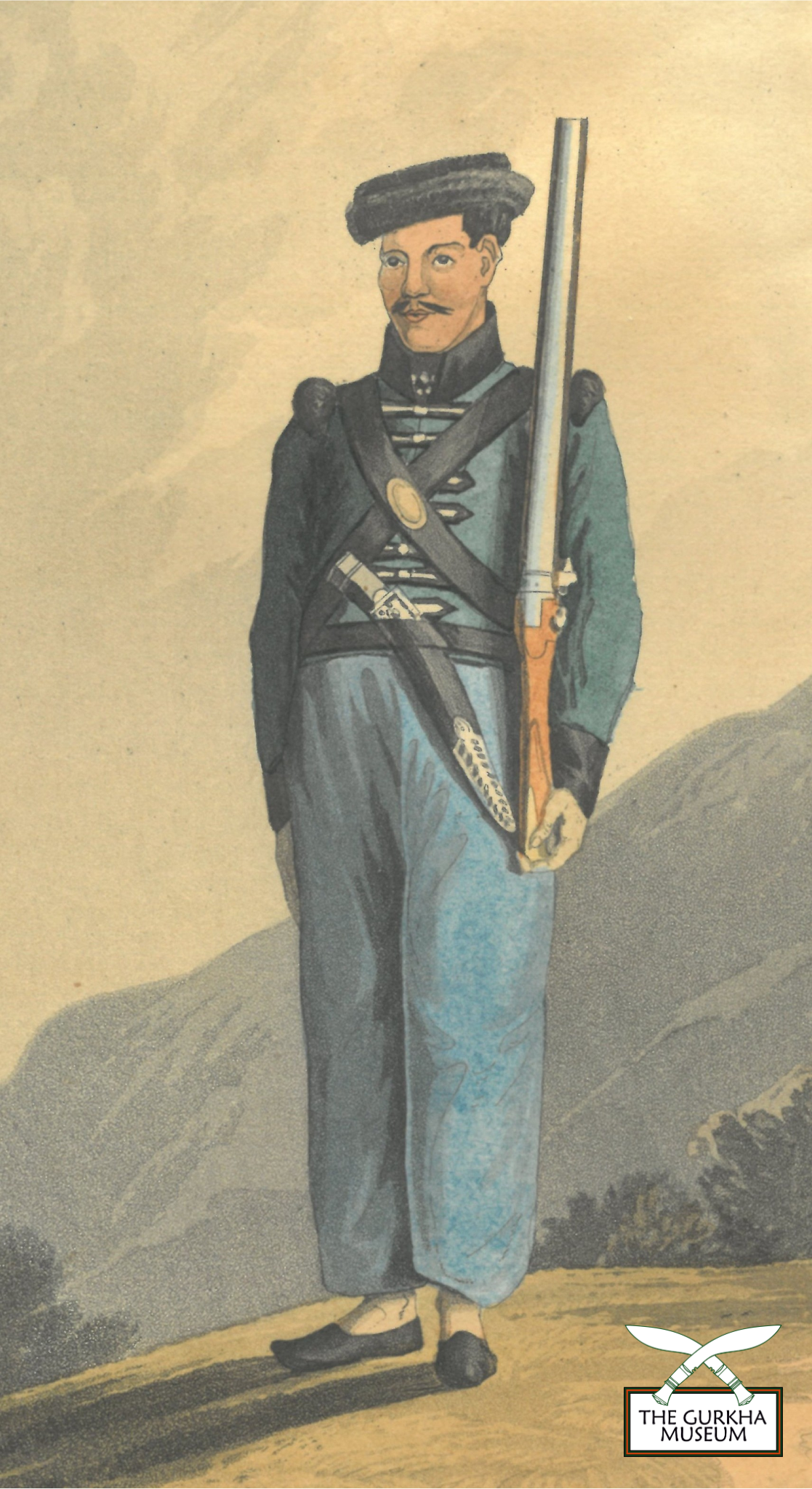
A Gurkha of the Sirmoor Battalion, c. 1819.
Over the following years, these Gurkha units would serve the HEIC across India’s North-West Frontier, acting largely as border security forces. They would at times fight large engagements, with early Gurkha actions including the Battle of Koonja in 1824. However, it would be the middle of the 19th century before the Gurkhas would truly establish their reputation in the Indian Army, particularly in the First Anglo-Sikh War (1845-1846) and the Indian Rebellion (1857-1859).
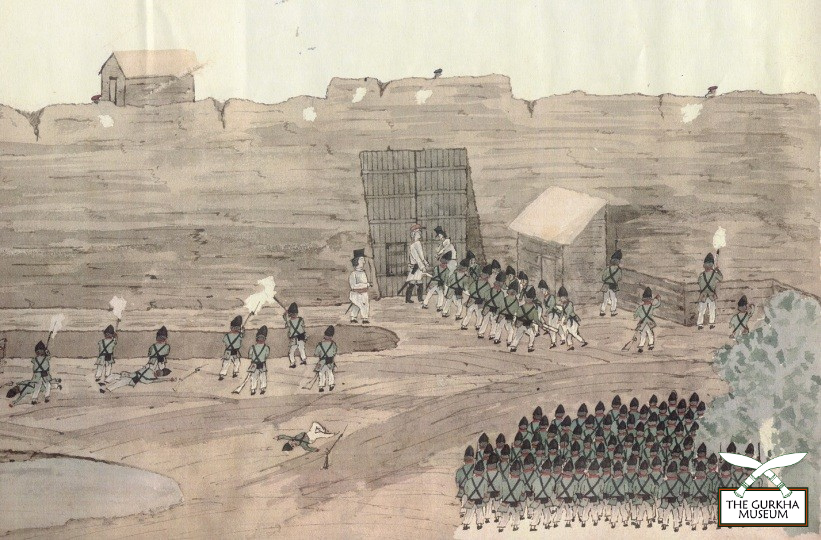
The Sirmoor Battalion storming the fortress of Koonja, October 1824.
During the Indian Rebellion, Nepal backed the British government and sent some of its troops to help keep order in India’s frontier regions. This solidarity marked a change in the relationship between the two countries, with Britain beginning to view Nepal as more of an equal partner. As a gesture of the increasing goodwill between them, Britain ceded the Terai region back to Nepal in 1860.
In subsequent years, the Anglo-Nepalese relationship flourished. Just over a century after Sugauli, this relationship was formalised with the signing of the Anglo-Nepal Treaty of 1923. This new treaty guaranteed perpetual friendship between the two states, and signified Britain’s official backing of Nepal’s status as a sovereign and independent nation. The treaty was later updated and re-ratified in October 1950 after the dissolution of British India and the formation of Pakistan rendered some parts of the original agreement moot.
Throughout the 20th century, Nepal continued to support Britain. One of its most profound acts of solidarity came on 4 September 1939, when it declared war on Germany just one day after its British ally.
It must also not be forgotten that Nepal’s contribution to the allied cause in both World Wars went beyond just the service of Gurkha soldiers. The Royal Nepalese Army was vital to the security of India’s North-West Frontier during both wars. Additionally, some Nepalese units, such as the Kali
Bahadur Regiment, fought alongside other Allied soldiers in the defence of India against Japanese invasion in 1944.
Britain and Nepal’s friendship continues into the present day, with both countries maintaining active embassies in the other’s capital.
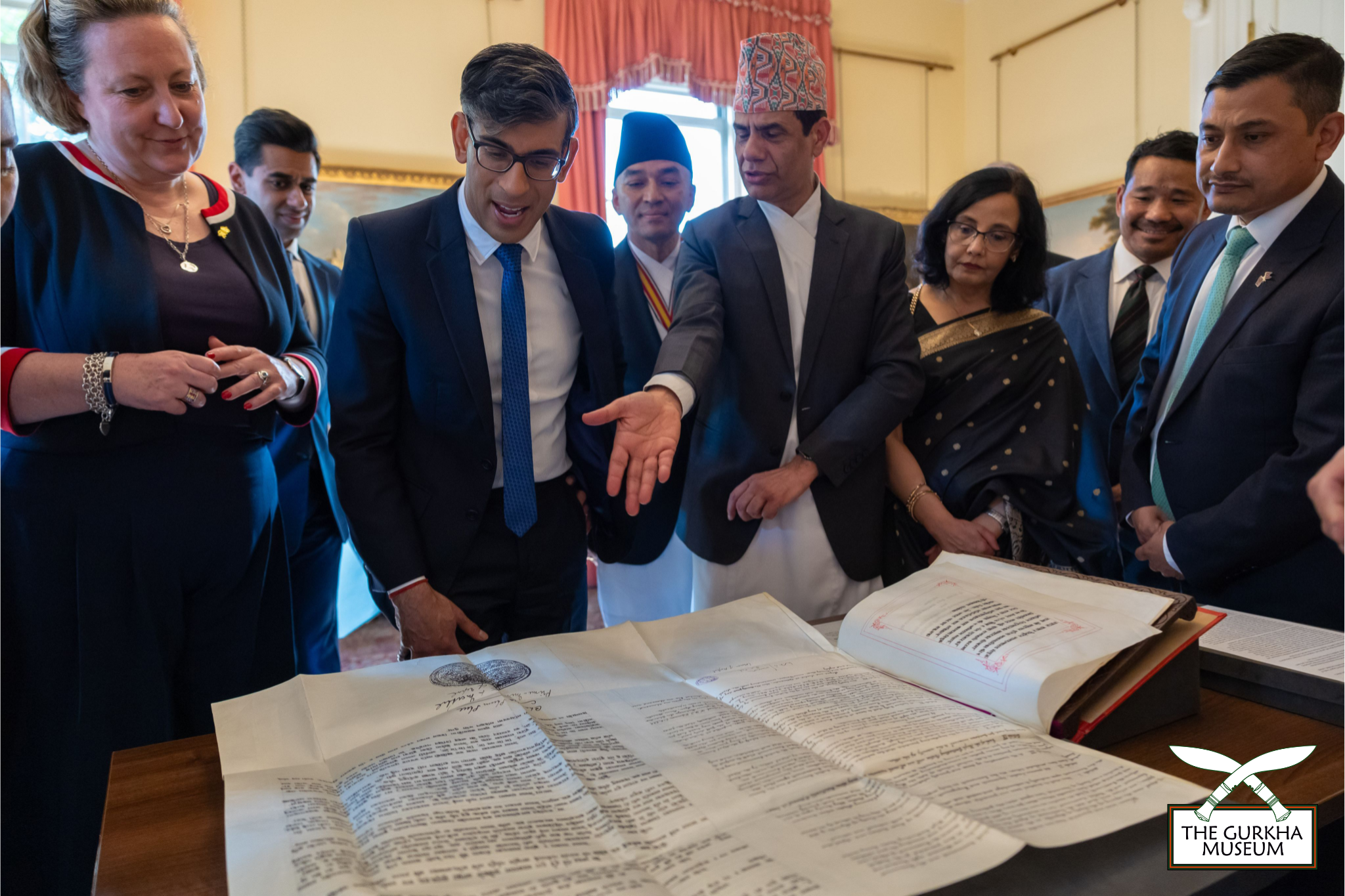
British Prime Minister Rishi Sunak and the Nepali Ambassador to the UK Gyan Chandra Acharya celebrate the 100th anniversary of the Anglo-Nepal Treaty at 10 Downing Street, 2023.
In Britain, the impact of the Anglo-Nepal relationship can be seen in the large British-Nepali community that has flourished across the country. This community has its roots in Gurkha service, with many Gurkha veterans retiring to the UK and settling with their families. As such, the British-Nepali community is most visible in places near to where Gurkha units are stationed, such as Aldershot, Folkstone and Nuneaton.
The British Army’s recruitment of Gurkha soldiers continues at the permission of the Nepalese government, with thousands of young men each year travelling to British Gurkhas Camp Pokhara to apply. As of 2026, around 4,500 Gurkha soldiers are serving in the British Army, making up roughly 5% of its total strength.